
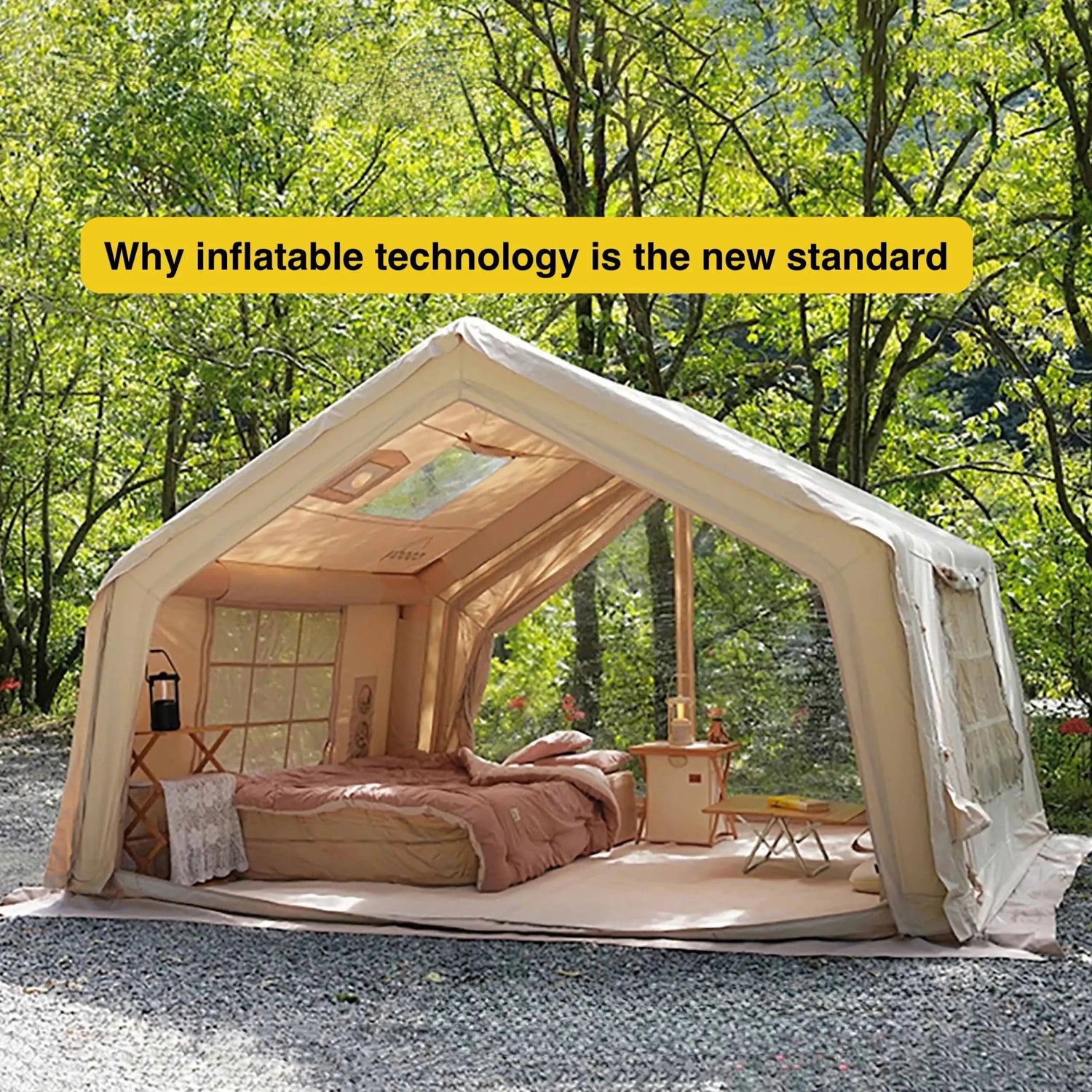
If you’re looking for the technical bottom line, here it is: high-end inflatable tents have officially outpaced traditional pole structures in both reliability and environmental control. Professional-grade models, specifically those from Coody, utilize 0.7mm TPU air beams pressurized to a 7.0 PSI gold standard. By replacing rigid metal with pressurized arches, these tents offer superior wind resistance - they flex under gusts and snap back into shape rather than bending or snapping. When paired with TC (Terylene Cotton) fabric and 420D silver-coated Oxford rainflies, these shelters solve the two biggest pain points in the industry: condensation management and one-person setup speed.
Table of Contents
- The evolution of the basecamp
- The physics of 7.0 PSI: why pressure equals survival
- Air beam anatomy: TPU vs. PVC
- Fabric engineering: 300D and 420D Oxford silver-coating
- The science of TC fabric: ending the condensation crisis
- Thermal insulation and the "Seasoning" effect
- Certified safety: beyond the fabric weave
- Hot tenting and winter performance: mastering the stove jack
- Thermal mass and heat retention
- All-weather protection: managing the hydrostatic head
- From bag to basecamp: the 5-minute one-person setup
- Structural ergonomics and interior volume
- Technical comparison: air beams vs. traditional poles
- The investment in outdoor longevity
The evolution of the basecamp
For decades, the mark of a "serious" basecamp was a heavy canvas wall tent or a complex geodesic dome held together by a spiderweb of aluminum poles. Anyone who has spent forty minutes wrestling with a bent pole in a freezing rainstorm knows that the traditional design has reached its limit. We are currently witnessing a fundamental shift in outdoor shelter engineering. We are moving away from structural hardware and toward high-pressure physics.
Inflatable tents were once dismissed as a novelty for casual summer campers. However, the technology has matured into high-performance habitats that are now the preferred choice for 4-season camping and professional glamping setups. Brands like Coody have effectively bridged the gap between the convenience of a pop-up tent and the ruggedness of an expedition-grade shelter.
This isn't just about saving time during the setup; it’s about the structural integrity of the habitat itself. A traditional pole is a point of failure - it can snap, splinter, or tear the fabric under tension. An air beam, by contrast, is a pressurized arch that distributes environmental loads across the entire frame. This guide breaks down the science of why air-based architecture, combined with advanced materials like TC fabric, is becoming the new benchmark for anyone who treats the outdoors as a second home.
The physics of 7.0 PSI: why pressure equals survival
When discussing inflatable shelters, the numbers dictate the performance. Most entry-level air tents on the market operate at a pressure between 3.0 and 4.5 PSI. While that sounds sufficient for a backyard, it is a critical failure point in high-altitude or coastal winds. Coody tents are engineered to a 7.0 PSI (0.48 bar) gold standard. This isn't just a higher number; it is the threshold where a pressurized beam begins to behave like a rigid, monolithic arch.
At 7.0 PSI, the air beams achieve the longitudinal stiffness required to withstand heavy snow loads and gale-force winds without buckling. To manage the risks of thermal expansion - where direct sunlight increases internal air pressure - the system includes integrated safety relief valves. These valves automatically vent excess air to maintain optimal tension, ensuring the frame remains rock-solid without risking seam failure during peak daylight heat.

Air beam anatomy: TPU vs. PVC
The "skeleton" of a high-end inflatable tent is only as good as its internal bladder. Many manufacturers cut costs by using PVC, which becomes brittle and prone to "cold cracking" when temperatures drop. Coody utilizes 0.7mm TPU (Thermoplastic Polyurethane) for all internal air chambers.
The advantages of TPU over PVC are non-negotiable for serious campers:
-
Extreme Temperature Resilience: TPU remains pliable and elastic down to -40°C, whereas PVC can fracture at the folds in freezing conditions.
-
Structural Dimensions: we utilize a 16Ø (160mm) beam diameter. This increased cross-section provides 23% more structural rigidity than the industry-standard 12cm tubes, allowing the tent to maintain its shape even before the guy lines are tensioned.
-
Zero Off-Gassing: unlike PVC, which often emits a strong chemical odor, TPU is an eco-friendly, non-toxic material that is safe for children and pets in enclosed spaces.
Fabric engineering: 300D and 420D Oxford silver-coating
While the air beams provide the shape, the fabric provides the protection. The main body of our tents uses 300D Oxford fabric, chosen for its high strength-to-weight ratio and resistance to mechanical abrasion. However, the real engineering secret lies in the 420D silver-coated Oxford rainfly.
This specialized outer layer serves two distinct functions. First, it achieves a 3000mm hydrostatic head (HH) rating, making it effectively waterproof against torrential rain. Second, the silver-coating acts as a thermal barrier, reflecting up to 90% of infrared and UV radiation. This keeps the interior temperature up to 10°C cooler in the summer and adds an extra layer of wind-blocking insulation during the winter. It’s the difference between sleeping in a sweltering plastic bag and a climate-controlled habitat.

The science of TC fabric: ending the condensation crisis
The biggest flaw in modern synthetic tents isn't their weight or setup time - it is their inability to breathe. In a standard polyester tent, the moisture from your breath hits the cold, non-porous walls and liquefies, creating a "raining" effect inside the cabin by 4:00 AM. This is a matter of physics, not a defect. To solve this, we utilize TC (Terylene Cotton) fabric, a high-performance blend of 65% polyester and 35% cotton.
TC fabric is hygroscopic. Unlike plastic-based fabrics that trap water vapor, the cotton fibers in TC material actually absorb moisture before it can condense. This vapor is then wicked through the weave and evaporated into the outside air. The result is a dry, stable microclimate that is significantly more comfortable for long-term habitation. For 4-season camping, this isn't a luxury, it is a necessity for preventing damp sleeping bags and hypothermia-inducing humidity.


Thermal insulation and the "Seasoning" effect
Technical Cotton does more than manage moisture, it acts as a thermal regulator. Because TC fabric is significantly denser - weighing in at 210g/m² - it creates a thicker barrier against external temperatures. In summer, the breathable weave prevents the "greenhouse effect" common in synthetic tents. In winter, the density of the fibers helps retain heat generated by a wood stove or internal heaters.
A unique characteristic of our TC material is the seasoning process. While the fabric has a laboratory-rated hydrostatic head of 2000mm–3000mm, its performance actually improves after the first few exposures to rain.
-
Fiber Swelling: when the cotton fibers get wet, they swell and close the microscopic gaps in the weave.
-
Permanent Waterproofing: once dried, the fibers retain this tighter configuration, creating a naturally waterproof barrier that doesn't rely solely on chemical coatings that flake off over time.
Certified safety: beyond the fabric weave
We believe the air you breathe inside your shelter is as important as the fabric protecting you from the rain. While budget manufacturers often use recycled plastics that emit volatile organic compounds (VOCs), our materials undergo rigorous KOLAS-accredited lab testing.
Our TC fabric and TPU beams are certified to be radon-free (tested at 0.37 pCi/L, well below the EPA safety threshold) and contain no detectable levels of lead, formaldehyde, or phthalates. This makes the interior environment safe for families, pets, and individuals with chemical sensitivities. When you are sleeping in a confined space for eight hours, the chemical purity of your shelter is a critical, though often overlooked, technical specification.
Hot tenting and winter performance: mastering the stove jack
A true 4-season inflatable tent is defined by its ability to maintain a livable interior temperature when the outside world drops below freezing. The centerpiece of this capability is the stove jack - a reinforced, fire-retardant port designed to facilitate the use of a wood-burning stove inside the tent.
At Coody, the stove jack isn't an afterthought, it is an integrated safety feature. Constructed from high-temperature resistant silicone-coated fiberglass, the port allows for high-heat chimney pipes to exit the tent without compromising the structural integrity of the TC fabric. When combined with a compact titanium or stainless steel stove, this setup transforms the tent into a heated habitat, capable of maintaining a comfortable 20°C (68°F) interior while external temperatures hover at -15°C.
Thermal mass and heat retention
The physics of winter camping come down to thermal retention. In a standard single-wall polyester tent, heat loss occurs almost instantly through radiation and convection. TC (Terylene Cotton) fabric, however, possesses significant thermal mass.
-
Insulation Barrier: the dense 210g/m² weave acts as an insulating layer, trapping a pocket of warm air between the inner cabin and the 420D Oxford rainfly.
-
Draft Prevention: unlike traditional tents with loose-fitting poles and gaps, the pressurized air beam frame creates a seamless seal against the ground, significantly reducing the "chimney effect" that sucks warm air out of the structure.
All-weather protection: managing the hydrostatic head
One of the most misunderstood metrics in the outdoor industry is the hydrostatic head (HH). Many believe that a higher number always equals a "better" tent. In reality, a rating of 3000mm HH - the standard for our rainflies - is more than sufficient to withstand a tropical downpour or heavy, wet snow.
The real secret to our winter performance is the dual-layer defense system:
-
The Outer Shield: the 420D Oxford silver-coated fly sheds 90% of the water and prevents snow from accumulating and melting directly onto the main body.
-
The Inner Breathable Shell: the TC fabric handles any residual moisture. While the outer layer stops the rain, the inner layer ensures that your own body heat doesn't create "internal rain" (condensation), which is the primary cause of dampness in winter conditions.

From bag to basecamp: the 5-minute one-person setup
The most significant barrier to frequent camping is often the logistical dread of the setup. Traditional pole-based shelters require a coordinated effort, usually involving two or more people wrestling with tensioned metal and complex fabric sleeves. An inflatable system removes this friction entirely, transforming the tent from a chore into a tool.
The setup process for a Coody inflatable tent is reduced to three functional steps: Unroll, Stake, and Pump. Because the TPU air beams are permanently integrated into the structure, there is no risk of losing components or misconfiguring the frame. A single person, using either a manual high-pressure pump or an electric 12V pump, can have a full-scale 4-season habitat standing in under five minutes. This speed is a critical safety factor when establishing a basecamp in fading light or rapidly deteriorating weather.
Structural ergonomics and interior volume
Beyond the speed of inflation, the geometry of an air-beam structure offers a distinct advantage in livable space. Traditional tents often feature sloped walls that sacrifice headrooms to maintain stability.
-
Vertical Wall Design: the rigidity of 7.0 PSI beams allows for nearly vertical side walls. This maximizes the "usable footprint," meaning you can place cots or gear directly against the edge of the tent without the fabric touching your face.
-
Integrated Ventilation: high-set windows and ground-level vents are built into the structural arches, ensuring consistent airflow even when the rainfly is deployed.
-
Heavy-Duty Flooring: the base is constructed from high-density, waterproof PVC, creating a "bathtub" floor that prevents groundwater ingress, even in saturated soil.
Technical comparison: air beams vs. traditional poles
To see the data-driven difference between these two technologies, refer to the performance metrics below:
|
Feature |
Coody Inflatable (7.0 PSI) |
Traditional Pole Tent (Alu/Fiber) |
|
Setup Time (1 Person) |
5 - 8 Minutes |
20 - 45 Minutes |
|
Wind Response |
Flexes and recovers instantly |
Bends permanently or snaps |
|
Structural Integrity |
High (TPU pressurized arches) |
Medium (Dependent on pole tension) |
|
Condensation Level |
Low (TC Breathable Fabric) |
High (Non-porous Polyester) |
|
Winter Suitability |
Excellent (Hot tenting ready) |
Limited (Heat loss through thin walls) |
|
Frame Lifespan |
10+ years (UV-protected TPU) |
3-5 years (Fiberglass fatigue) |
The investment in outdoor longevity
Choosing a shelter is ultimately a choice between a "disposable" camping accessory and a long-term outdoor investment. The combination of TC breathable canvas, 0.7mm TPU engineering, and radon-free certification places Coody tents in a different category than standard retail gear.
When you remove the failure points of traditional poles and the discomfort of polyester condensation, the outdoors becomes a more accessible, safer environment. Whether you are establishing a winter basecamp for hot tenting or a summer family retreat, the science confirms that pressurized air is the most reliable foundation for the modern explorer.
Frequently asked questions
🏕 Can an inflatable tent withstand high winds?
Yes. While a metal pole can snap under extreme lateral pressure, a 7.0 PSI air beam is designed to flex. During a high-wind event, the beam may slightly displace to absorb the energy of a gust and then immediately "snap" back into its original shape. This makes it structurally safer in unpredictable mountain or coastal environments.
📦 Do air beams leak over time?
Premium TPU (Thermoplastic Polyurethane) bladders are hermetically sealed and designed for long-term pressure retention. Unlike cheap PVC imitations, TPU does not become porous with age. Most "leaks" are actually just air contracting due to cold temperatures (Physics: Charles's Law), a simple 30-second top-off with the pump restores full rigidity.
💡 Is the tent too heavy for solo transport?
While TC fabric and heavy-duty air beams are heavier than ultra-light backpacking nylon, they are designed for vehicle-based camping (overlanding) and basecamps. The weight is a trade-off for durability and 4-season protection that a 2lb nylon tent cannot provide.
0 comments