
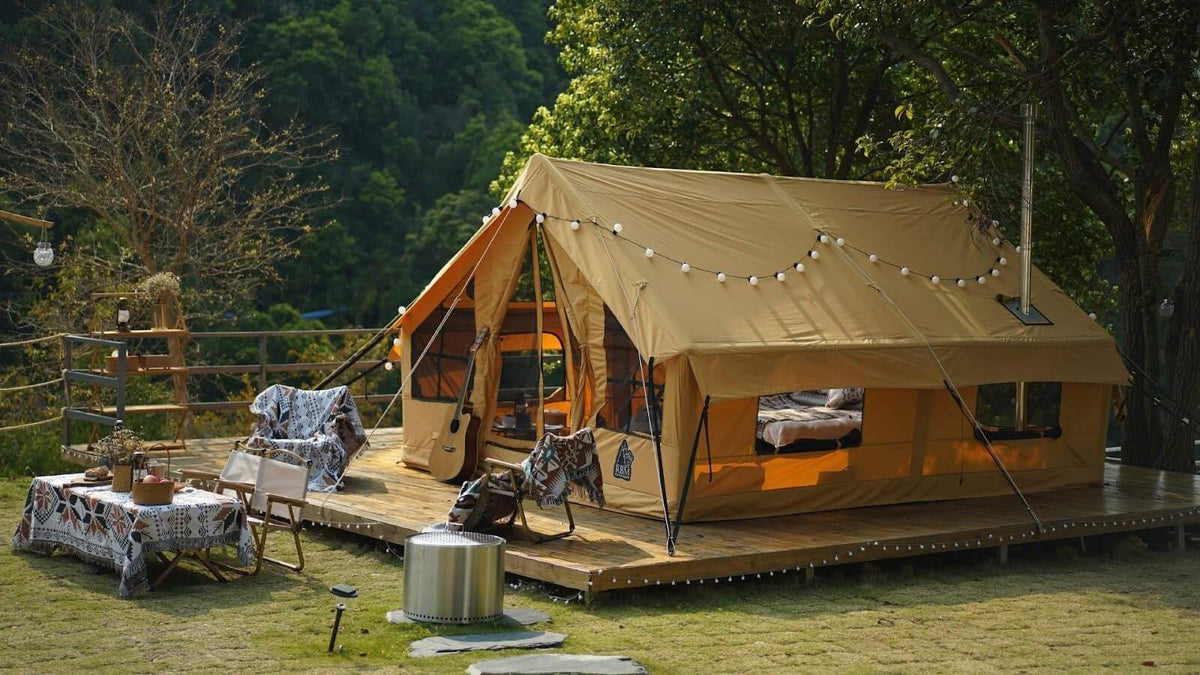
Carpas glamping inflables ofrecen altura suficiente para estar de pie y espacio para zonas de descanso y convivencia sin un armazón rígido de postes. El mejor modelo depende del número de campistas, la construcción del suelo, la altura interior, el peso empaquetado, el tiempo de montaje, la distribución de las ventanas, la compatibilidad con la estufa y las condiciones meteorológicas previstas.
¿Qué diferencia a una carpa glamping inflable?
Las carpas inflables utilizan tubos de aire de PVC en lugar de un armazón convencional de postes. Los modelos Coody funcionan a una presión recomendada de 6-8 psi, y sus estructuras de aire se inflan y se someten a pruebas de presión durante 72 horas para comprobar si hay fugas. El montaje aún requiere preparar el terreno, aplicar la presión correcta, anclar completamente la carpa e instalar los paneles y el toldo impermeable específicos del modelo.
Tejido TC y clasificaciones meteorológicas de Coody
Las carpas inflables Coody utilizan tejido TC de 210 g/m² compuesto por un 65 % de poliéster y un 35 % de algodón. El cuerpo de la carpa tiene una clasificación PU2000+, y el toldo impermeable de Oxford 420D tiene una clasificación PU3000+. La gama se ha probado para resistir vientos de hasta 72 km/h (45 mph) y ofrece protección UV UPF 50+. Estas especificaciones no garantizan el rendimiento en todas las tormentas o campamentos.
El rango de funcionamiento aprobado para las carpas inflables Coody y Panda es de -10 °C a +40 °C (14 °F a 104 °F). Después de usar cualquier carpa por debajo de 0 °C (32 °F), seca completamente cada sección en un espacio interior cálido y seco antes de guardarla.

Coody 17.2 Familia
Coody 17.2 es una carpa con estufa inflable de dos habitaciones para 2-10 personas. Ofrece 17.2 m² (185.14 ft²), una altura exterior de 2.2 m (86.61"), una altura de techo de 2.04 m (80.31") y un montaje de aproximadamente 10 minutos. La habitación delantera tiene un suelo Oxford extraíble, mientras que la trasera tiene un suelo de PVC integrado.
La carpa tiene seis ventanas, incluidas dos ventanas de techo, dos puertas, un separador extraíble y una salida de chimenea de 10 cm (3.94"). El peso neto es de 66 kg (145.51 lb) y el peso bruto es de 72.5 kg (159.84 lb). La presión recomendada es de 6-8 psi, no una presión fija de 7 psi.

Panda Large
Panda Large es una carpa de lona inflable para hasta seis personas. Ofrece 12 m² (129.17 ft²), una altura exterior de 2.2 m (86.61"), una altura de techo de 2.08 m (81.89") y un montaje de aproximadamente 7 minutos. Tiene un suelo de PVC, ocho ventanas, dos puertas y una salida de chimenea de 10 cm (3.94").
El peso neto es de 48 kg (105.82 lb) y el peso bruto es de 51 kg (112.44 lb). Su toldo impermeable está fabricado con tejido Oxford recubierto de plata y tiene una clasificación PU2000. La carpa es portátil y no está diseñada como refugio permanente. Los registros actuales no respaldan describir sus ventanas como un sistema de cinco capas.
Comparación entre Coody 17.2 y Panda Large
|
Característica |
||
|
Superficie útil |
17.2 m² (185.14 ft²) |
12 m² (129.17 ft²) |
|
Altura exterior / de techo |
2.2 / 2.04 m |
2.2 / 2.08 m |
|
Peso neto / bruto |
66 / 72.5 kg |
48 / 51 kg |
|
Tiempo de montaje |
10 min |
7 min |
|
Salida de chimenea |
10 cm (3.94") |
10 cm (3.94") |
|
Ventanas |
6, incluidas 2 ventanas de techo |
8 ventanas |
Otras formas de Coody
Coody Hub ofrece 12.96 m² (139.50 ft²), una altura exterior de 2.75 m (108.27") y una altura de techo de 2.59 m (101.97"). Aurora Dome ofrece 16.4 m² (176.53 ft²), 11 ventanas, tres puertas y un suelo Oxford extraíble con una lona de suelo adicional de PVC. Bestona ofrece una distribución octagonal de 12 m² (129.17 ft²) con una altura de techo de 2.55 m (100.39").

Cómo elegir
- Comienza por el número de personas que dormirán en la carpa y luego añade superficie para camas, equipaje, muebles y una zona para la estufa.
- Elige la construcción del suelo de forma consciente: los suelos de PVC integrados y los suelos Oxford extraíbles responden a diferentes necesidades de limpieza y campamento.
- Compara el peso neto, el peso bruto y el número y las dimensiones de las cajas de envío antes de planificar el transporte.
- Confirma los paneles incluidos, la lona de suelo, la alfombra, la bomba, el conector y el toldo impermeable de la ficha exacta del producto.
- Para usar una estufa, confirma el diseño actual de la salida de chimenea y sigue las instrucciones tanto de la carpa como de la estufa.
Cuidados después del viaje
Retira la suciedad de las válvulas y del tejido, deja salir el aire sin forzar los pliegues fríos y seca completamente la carpa antes de guardarla. El tejido TC húmedo puede desarrollar moho, malos olores, manchas y daños materiales. Evita la exposición prolongada a la luz solar directa cuando la carpa no esté en uso.
0 comentarios