
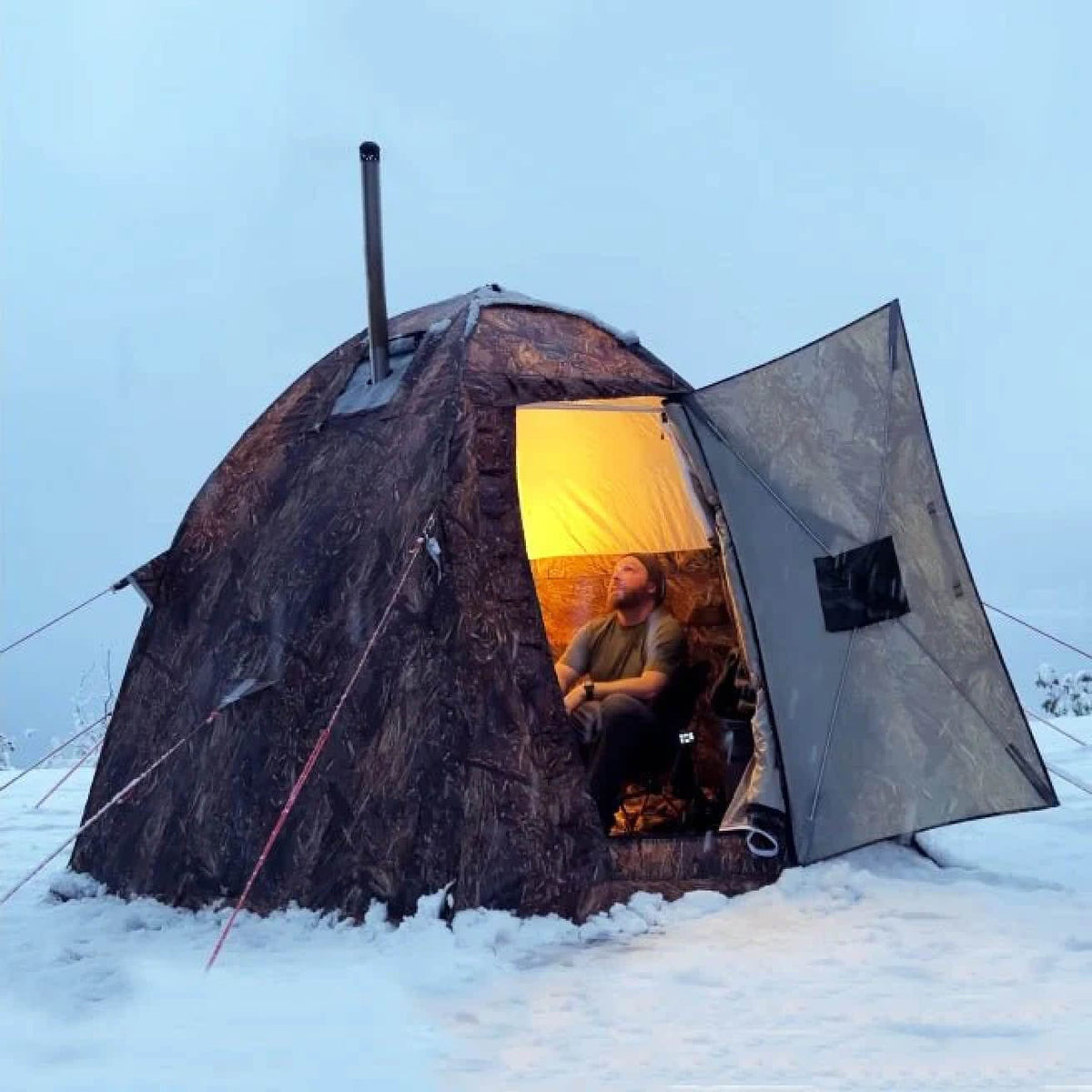
El camping en carpa caliente de invierno añade un sistema de calefacción, chimenea, protección contra incendios y mantenimiento para climas fríos a la lista normal de camping. Cada elemento debe corresponder a la temperatura, el viento, la nieve, el acceso, el tamaño del grupo y las normativas vigentes contra incendios previstos. Prueba el sistema completo antes de viajar.
1. Elige el refugio
Compara la capacidad con y sin estufa, ya que la estufa y el espacio libre necesario reducen el espacio utilizable. RBM UP-5 tiene capacidad para hasta seis personas sin estufa o hasta cinco con una, ofrece 13.1 m² (141.01 ft²) y se instala en aproximadamente 3 minutos. Su estructura utiliza una aleación de aluminio B95T1 de grado aeronáutico con varillas de 10 mm (0.39").
Coody 17.2 ofrece 17.2 m² (185.14 ft²), tiene capacidad para entre 2 y 10 personas y se instala en aproximadamente 10 minutos. Panda Large ofrece 12 m² (129.17 ft²), tiene capacidad para hasta seis personas y se instala en aproximadamente 7 minutos. Las carpas inflables Coody y Panda tienen un rango aprobado de -10 °C a +40 °C (14 °F a 104 °F) y deben secarse completamente en interiores después de usarse por debajo del punto de congelación.
2. Lleva el sistema completo de estufa
- Estufa y chimenea compatibles con la configuración exacta de la salida de chimenea
- Cada segmento de la chimenea, apagachispas y deflector necesario
- Alfombrilla para estufa resistente al fuego y protectores térmicos
- Guantes resistentes al calor, pala y las herramientas incluidas con la estufa
- Detector de humo y detector de monóxido de carbono en funcionamiento, con baterías probadas
Caminus S tiene una cámara de combustión de 230 x 320 x 200 mm (9.05 x 12.59 x 7.87"), una chimenea de 65 mm (2.56") y un peso neto de 10.7 kg (23.58 lb). Caminus M tiene una cámara de combustión de 250 x 500 x 250 mm (9.84 x 19.68 x 9.84"), una chimenea de 80 mm (3.15") y un peso neto de 16.5 kg (36.37 lb). Verifica la compatibilidad; el tamaño de la estufa por sí solo no determina la instalación correcta en la carpa.
3. Prepara un sistema para dormir en climas fríos
- Saco de dormir adecuado para la temperatura mínima prevista y para la persona que lo usará
- Colchoneta aislante adecuada para suelo congelado
- Capas secas para dormir, gorro abrigado, guantes y calcetines de repuesto
- Aislamiento de respaldo que siga siendo eficaz si la estufa no está funcionando
Una estufa para carpa complementa el sistema para dormir. No debe considerarse la única protección contra el frío nocturno, porque no se puede dejar la estufa sin supervisión mientras los ocupantes duermen.

4. Protege el suelo y controla la humedad
El suelo opcional de tres capas UP-5 utiliza capas exteriores de Oxford 300D PU4000 con aislamiento de Foil Isolon. Añade aislamiento del suelo, pero no sustituye la alfombrilla para estufa resistente al fuego. Las cubiertas de suelo y las alfombras deben ajustarse al modelo exacto de carpa y permanecer secas antes de guardarlas.
5. Ancla la carpa para condiciones invernales
- Lleva el juego completo de estacas y vientos del modelo, además de los anclajes adecuados para nieve, hielo o tierra.
- Elige un terreno nivelado, alejado de árboles muertos, zonas de avalanchas, cauces de inundación y peligros expuestos al viento.
- Mantén las salidas, las aberturas de ventilación y el área de la chimenea despejadas de nieve.
- Retira la nieve acumulada del techo; no debe inferirse ninguna capacidad de carga de nieve no publicada.
6. Ropa, agua, comida e iluminación
Lleva capas base que gestionen la humedad, capas intermedias aislantes, capas exteriores impermeables, calzado de invierno y repuestos secos. Lleva suficiente agua o un método fiable de tratamiento, comida para posibles retrasos, utensilios de cocina y únicamente el equipo de cocina permitido en el lugar seleccionado. Guarda la comida y los artículos con olor de acuerdo con las normas locales sobre fauna silvestre.
- Una linterna frontal para cada persona, baterías de repuesto y una linterna alternativa
- Herramientas de navegación, dispositivos de comunicación cargados y un plan del viaje compartido con un contacto de confianza
- Botiquín de primeros auxilios, medicamentos personales, refugio de emergencia, kit de reparación y piezas de repuesto específicas del modelo
Prepara tu campamento de invierno definitivo: Tanto si prefieres la instalación rápida de una estructura de aluminio de grado aeronáutico como el amplio lujo de una cabaña inflable premium, encuentra el refugio perfecto para cuatro estaciones para tu próxima aventura en climas fríos.
Carpa RBM UP-5
Ver productoCoody 17.2 Air Tent
Ver producto7. Límites de funcionamiento de la estufa
- Primer encendido en exteriores durante al menos 1 hora
- Distancia mínima de 50 cm (19.6") respecto a los objetos circundantes
- Salida de la chimenea al menos 50 cm (19.6") por encima de la cumbrera
- Combustible equivalente como máximo a dos tercios del volumen de la cámara de combustión
- Funcionamiento continuo máximo de 7 horas
- Limpieza de la chimenea después de cada 10 horas de uso
- Ventilación continua y supervisión activa
Antes de abandonar el campamento
Deja que la estufa se enfríe por completo, limpia la ceniza y los componentes de la chimenea, inspecciona la salida de chimenea y la alfombrilla, y guarda todas las piezas secas. Las carpas Coody inflables y Panda utilizadas por debajo de 0 °C (32 °F) deben secarse completamente en un espacio interior cálido y seco antes de guardarlas.
0 comentarios