10-15 Business days (Customers are responsible for paying customs and duty fees separately)
Alaska, Hawaii
$160
22-26 Business days
Developed by South Korean engineers · 1-year warranty
Description
The OX Diesel Heater X10 from OX OUTDOOR & EXTREME BY RBM brings controlled diesel heat to camping and overlanding. Developed by South Korean engineers, it keeps the heater outside and delivers warm air into your tent through ducts.
Up to 10 kW of heat: select one 5 kW core or both to match your heating needs.
AUTO climate control + wireless remote: set your preferred temperature from inside the tent. AUTO adjusts heating output toward your target. You can also choose 10 MANUAL heat levels; Stop & Go is a separate automatic stop/restart mode.
Two built-in CO sensors: one in the heater and one in the remote add a layer of protection. Keep the remote charged, on and connected.
No firewood or ash: the external 5.3 US gal (20 L) diesel tank supplies the fuel. Bring suitable electrical power for the controls, pump and fans.
Ready for U.S. power: the supplied power unit has a U.S. plug on its cable. No plug adapter is needed; the heater itself uses 12V DC.
Plan suitable electrical power for startup, operation and cooldown. Keep power connected until the cooling cycle finishes.
Install the heater, fuel tank and exhaust outdoors. Follow the manual and use a separate working CO alarm. Heating performance and fuel use depend on tent size, insulation, weather and output. A battery, diesel, tent and optional heated floor are purchased separately.
Free U.S. shipping from our U.S. warehouses. Canada shipping: US$140. Includes a 1-year warranty, subject to RBM Outdoors warranty terms.
1 / 17
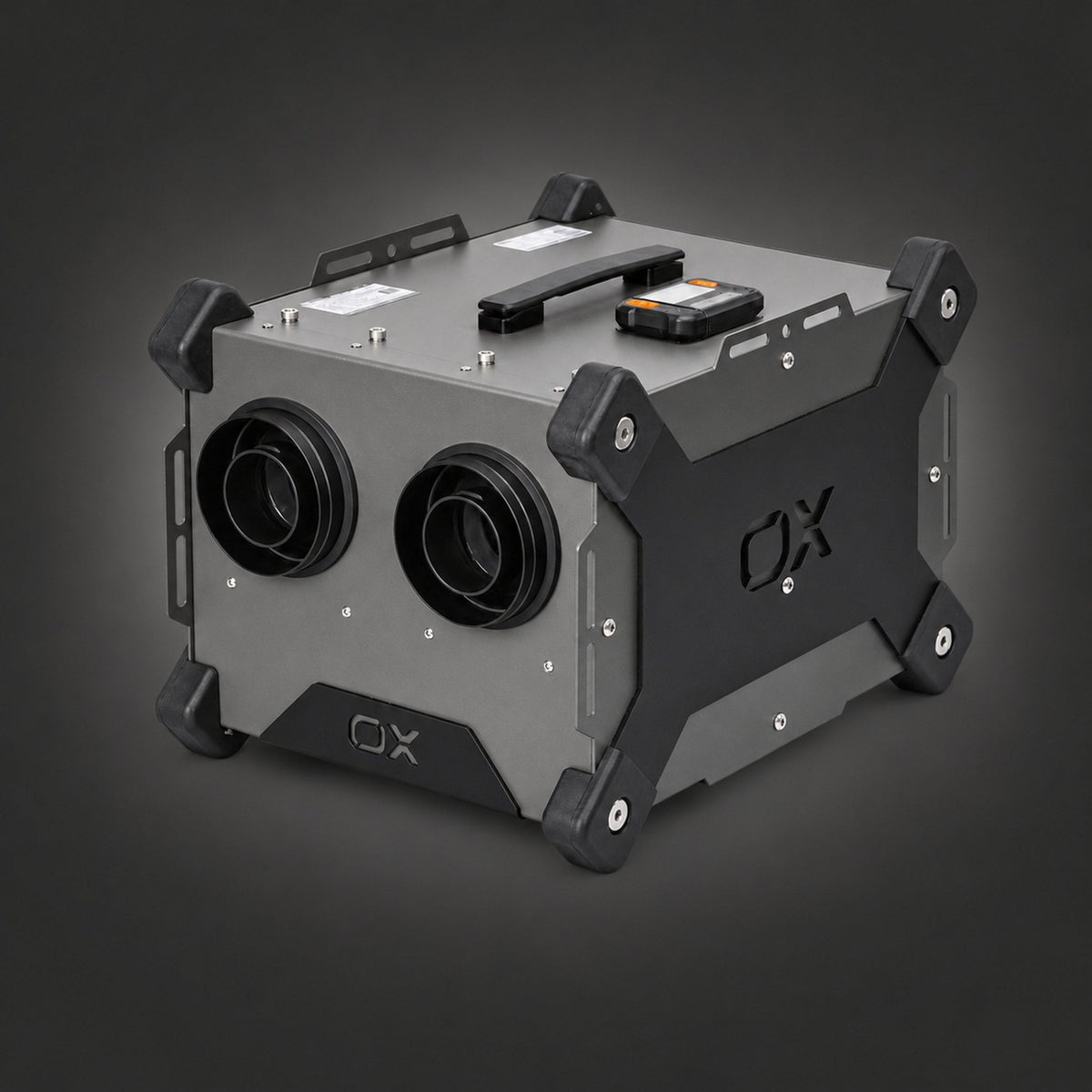
OX Diesel Heater X10 with dual air outlets and wireless remote against a softly lit dark background
2 / 17
OX Diesel Heater X10 — 10 kW Portable Diesel Air Heater with Wireless Remote
3 / 17
OX Diesel Heater X10 — 10 kW Portable Diesel Air Heater with Wireless Remote
4 / 17
OX Diesel Heater X10 — 10 kW Portable Diesel Air Heater with Wireless Remote
5 / 17
OX Diesel Heater X10 — 10 kW Portable Diesel Air Heater with Wireless Remote
6 / 17
OX Diesel Heater X10 — 10 kW Portable Diesel Air Heater with Wireless Remote
7 / 17
OX Diesel Heater X10 — 10 kW Portable Diesel Air Heater with Wireless Remote
8 / 17
OX Diesel Heater X10 — 10 kW Portable Diesel Air Heater with Wireless Remote
9 / 17
OX Diesel Heater X10 — 10 kW Portable Diesel Air Heater with Wireless Remote
10 / 17
OX Diesel Heater X10 — 10 kW Portable Diesel Air Heater with Wireless Remote
11 / 17
OX Diesel Heater X10 — 10 kW Portable Diesel Air Heater with Wireless Remote
12 / 17
OX Diesel Heater X10 — 10 kW Portable Diesel Air Heater with Wireless Remote
13 / 17
OX Diesel Heater X10 — 10 kW Portable Diesel Air Heater with Wireless Remote
14 / 17
OX Diesel Heater X10 — 10 kW Portable Diesel Air Heater with Wireless Remote
15 / 17
OX Diesel Heater X10 — 10 kW Portable Diesel Air Heater with Wireless Remote
16 / 17
OX Diesel Heater X10 — 10 kW Portable Diesel Air Heater with Wireless Remote
17 / 17
OX Diesel Heater X10 — 10 kW Portable Diesel Air Heater with Wireless Remote
OX Diesel Heater X10 — 10 kW Portable Diesel Air Heater with Wireless Remote
Prix habituel$2,390.00 USD
Prix habituelPrix soldé$2,390.00 USD
Prix unitaire/ par
OX X10. Warm your tent. Enjoy the cold.
Outdoor setup shown. Connect all components according to the operating instructions before starting the heater.
Keep the heater outside and bring warm air into your tent through ducts. No firewood to split, logs to keep adding or stove ash to clean up.
Developed by South Korean engineers for controlled heat in cool and cold weather.
One carbon monoxide sensor in the heater; a second in the wireless remote inside your tent. Keep the remote charged, switched on and connected.
Built-in protection complements proper outdoor installation and ventilation. Use a separate working CO alarm as directed in the manual.
Is X10 worth the extra $600?
Choose by the heat your camp needs. X10 adds heating capacity; X5 is the lighter, more compact option.
OX Diesel Heater X5
$1,790 USD
For a lower heating demand and easier packing.
One core, up to 5 kW
One warm-air outlet
22.5 lb (10.2 kg) heater body
18.1 × 7.3 × 12.2 in (46 × 18.5 × 31 cm)
OX Diesel Heater X10
$2,390 USD
For a larger or more demanding camp that needs extra heat.
Two selectable cores, up to 10 kW
Two warm-air outlets
36.4 lb (16.5 kg) heater body
18.1 × 13.4 × 12.2 in (46 × 34 × 31 cm)
Included with both: wireless remote, two built-in CO sensors, MANUAL, AUTO, Stop & Go, timer and fan-only mode.
Your X10 package: heater, remote, ducts, exhaust and muffler, external tank, fuel line, power cable, U.S.-plug power supply and two transport bags. Battery, diesel and optional heated floor are separate.
Required heat depends on tent volume, insulation and weather. Two outlets do not provide separately set room temperatures.
Two selectable heating cores. Warm air inside. Remote control from your tent. See the controls and real field tests, then explore the connections. Choose a topic and press play for sound.
More heat when you need it.
Choose A, B or A+B on the remote. A or B: one core heats. A+B: both cores heat.
Select A or B for one heating core, or A+B for both. This is the clearest way to understand what makes X10 different: two selectable sources of heat in one body.
Choose the output for the conditions. The two outlets do not provide independently set room temperatures.
See the temperature inside.
About 70°F (21°C).
A close-up frame from the winter-camping test, held so you can read the thermometer.
This setup also uses an optional heated floor. It is one field observation, not a promised temperature or a test of the standard heater alone.
Hear it outside. Then inside.
Watch the meter. Listen to the original operating sound.
First, beside the heater outdoors. Then, in the center of the tent. Close-up views make the changing decibel readings easier to see.
These excerpts use pauses without commentary and retain the original heater and background sound. Distance and surroundings affect the readings; playback volume is not a calibrated sound level.
Connect your diesel supply.
Quick-connect fuel line. Connect the external diesel tank to the heater.
The external tank connects to the X10 through a quick-connect fuel line. Check the connection and fuel system before starting.
Prime an empty line only as directed in the manual. Fuel use depends on the selected output and conditions.
Keep the exhaust outdoors.
Connect the exhaust securely. Keep exhaust outside and away from tent openings.
Secure the exhaust and muffler components as shown in the installation instructions. Position the outlet away from people, tent openings and air intakes.
Keep the exhaust clear of snow, standing water and other obstructions.
Connect the two air paths.
Flexible ducts connect to the heater. Warm air goes into the tent. The heater stays outside.
The inner passage delivers warm air; the surrounding return path takes tent air back to the heater. Secure both parts and keep the passages open.
Recirculation does not replace the ventilation required by your tent and heater instructions.
Aim the warmth into your space.
Aim the swivel outlets. Direct the airflow toward your living area.
Position the outlets inside the tent and direct the airflow toward your living area. Keep the air path clear rather than pushing an outlet under bedding.
Plan the duct entry points before arranging beds, tables and other furniture.
Check the port, not just the battery size.
12V DC power with an XT90 connection. Check startup demand. Battery sold separately.
The X10 needs a suitable 12V DC source. Check the voltage, polarity and startup capacity of the exact power-station port and cable you will use.
A large Wh rating alone does not prove compatibility. Allow for startup demand up to 130 W.
Give the heater its own space.
The heater and fuel tank stay outside. Warm air reaches your tent through the connected ducts.
Place the heater securely outdoors on a stable, noncombustible surface. The tank and exhaust stay outside too; a closed vestibule is not an outdoor location.
Route the ducts through suitable tent openings and follow the manual’s clearances.
This is where the warm air arrives.
The open air outlets sit inside the tent. Keep the outlets clear of bedding and gear.
The open ends of the ducts extend into the tent and deliver the heated air. The actual installation footage shows their correct position.
Keep outlets and return openings free of furniture, bedding and loose gear.
Wireless remote shown in MANUAL mode.
Adjust the warmth without stepping outside.
AUTO climate control: set your preferred temperature from about 46–97°F (8–36°C) on the wireless remote. The heater adjusts output toward your target, helping keep your tent comfortable as conditions change.
Stop & Go: a separate mode pauses and restarts heating as needed. It can reduce unnecessary fuel use; savings depend on weather, insulation and settings. Every restart needs startup power.
MANUAL: choose one of 10 heat levels when you want direct control of heating output.
More heat when your camp needs it.
Two independently selectable 5 kW heating cores deliver up to 10 kW of heat. Use one for a lighter heating demand, or both when you need more output. That is twice the maximum heat output of X5, with capacity to handle a more demanding camp.
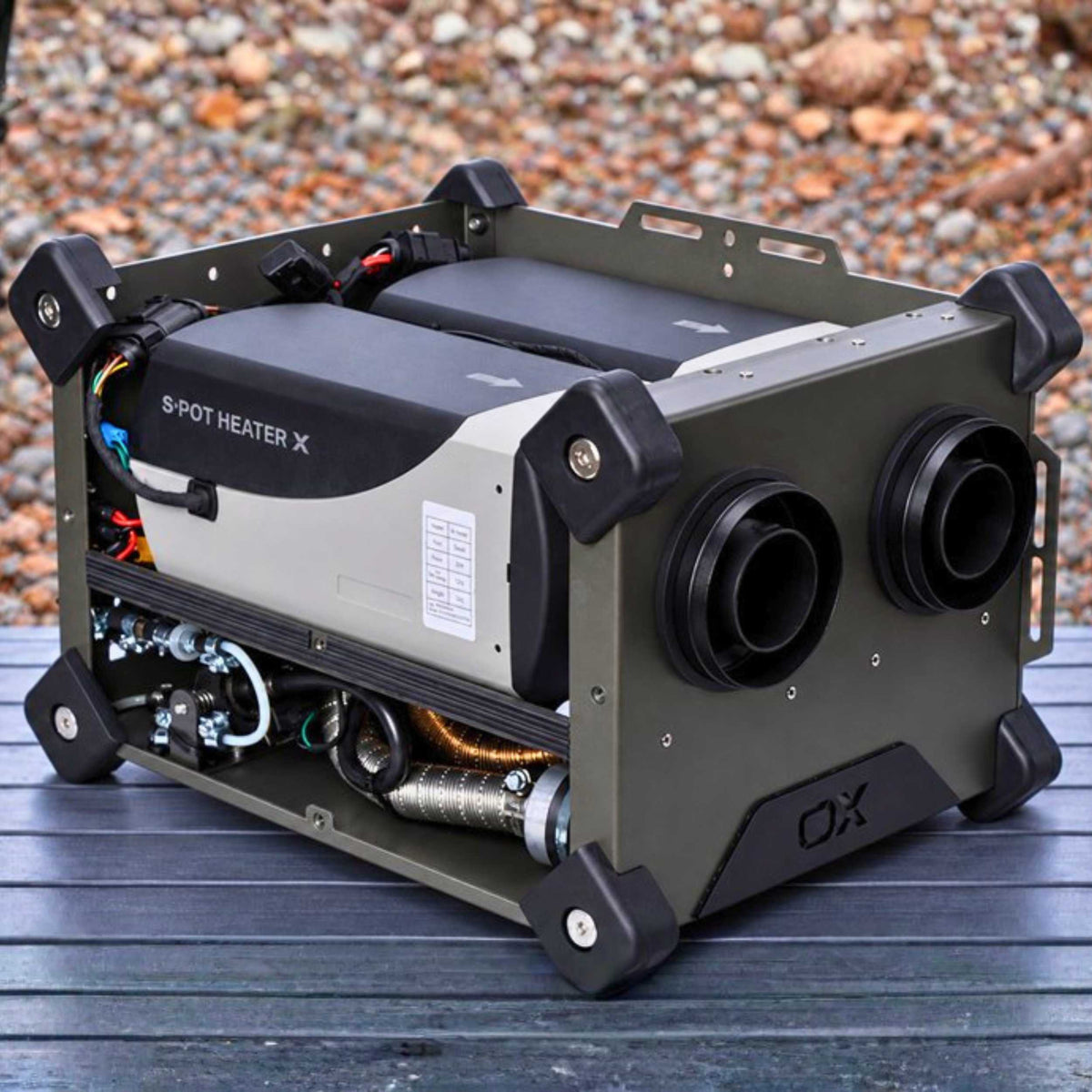
Internal view for explanation only. Operate with the housing assembled. Heated area depends on insulation, weather and heat loss.
Warm air inside. Firewood and ash out.
The heater, diesel tank and exhaust stay outdoors. Warm air enters through ducts, leaving more floor space for beds and gear. No wood to split, logs to carry inside or stove ash to clean up.
The coaxial ducts carry warm air in and return tent air through a separate passage. Keep the air openings clear.
Follow the installation clearances and ventilation requirements. Use a separate, working CO alarm.
Feed the heater from a tank, not an armful of logs.
A quick-connect fuel line supplies diesel from the external tank. Once the system is properly connected and running, it provides warm air without the repeated log-loading a wood stove needs.
Bring enough diesel and suitable electrical power for your trip. Fuel use varies with heating output.
Stop the heater and let it cool before refueling. Follow the supplied operating instructions.
Rain outside. Comfort inside.
The X10 has a rain-resistant housing designed for outdoor placement. Its aluminum body and protective corner bumpers suit a setup that stays outside while you enjoy the space indoors.
Follow the outdoor installation instructions. Protect power connections and the adapter, keep the remote indoors, and keep the heater out of standing water.
Field readings, with context.
About 70°F (21°C) and 44 dB inside were reported in a winter-camping setup that also used an optional heated floor.
Sound was measured outside by the heater and inside the tent. Watch the meter in the video; playback volume is not a calibrated sound level.
The tent model and size, outside temperature, elapsed heating time and selected mode are not documented here. These observations are not a controlled test of the standard package or a promised result.
A complete system. Every part has a job.
Meet the components of the X10 package, from the two air paths to the external diesel tank. The heater and accessories travel in separate bags.
The heater
One X10 body with two heating cores and a carry handle.
Wireless control
Remote with batteries. Keep it in the heated living space.
Warm-air ducts
Two ducts, each 2.36 in (6 cm) in diameter, carry warmed air into the tent.
Return-air ducts
Two ducts, each 4.09 in (10.4 cm) in diameter, form the coaxial air system.
Exhaust & muffler
Exhaust components keep combustion gases outside the living space.
External diesel tank
5.3 US gal (20 L) capacity. Diesel is purchased separately.
Quick-connect fuel line
About 118.1 in (3 m) of fuel line with a check valve.
Two transport bags
Separate storage for the heater and accessories.
The numbers. And what they mean.
10 kW describes heat from diesel. It is not a 10,000-watt load on your battery. The electrical system runs the fan, pump and controls.
OX X10 specifications
Specification
X10
For your camp
Heating output
Up to 10 kW · two 5 kW cores
Select A, B or A+B to suit your heating needs.
Temperature control
AUTO: about 46–97°F / 8–36°C
Output adjusts toward the selected temperature; results depend on heat loss.
Manual control
10 power levels
Choose the heating level directly.
Heater power input
12V DC · XT90
AC operation uses an external power supply.
U.S. configuration
U.S. plug on the power-supply cable
No plug adapter needed. The supplied power unit converts AC to the heater’s 12V DC input.
Electrical draw
10–80 W while running
Allow for startup demand up to 130 W and keep power on through cooldown.
Fuel
Diesel
Use fuel suitable for the outside temperature and follow the supplied manual.
Fuel consumption
About 0.04–0.29 US gal/h (0.15–1.10 L/h)
Actual use varies with output and operating conditions.
Tank capacity
5.3 US gal (20 L)
External tank; runtime also depends on your power supply.
Body dimensions
18.1 × 13.4 × 12.2 in (46 × 34 × 31 cm)
Allow extra room for ducts, connections and exhaust.
Body weight
36.4 lb · 16.5 kg
Fuel, battery and accessories add to the transport weight.
Operating functions
MANUAL · AUTO · Stop & Go · timer · fan
Fan-only mode circulates air; it is not air conditioning.
Outside operating temperature
−40 to 68°F (−40 to +20°C)
Use winter-grade diesel appropriate for the conditions; keep air paths and exhaust clear.
Warranty
1 year
Subject to RBM Outdoors warranty terms.
Know the setup. Enjoy the camp.
Follow the supplied manual for the complete installation and operating procedure.
Diesel makes the heat. Your power station runs the system.
Off-grid, bring a compatible power station or a suitable separate 12V battery. At a powered campsite, use the supplied power unit with its U.S. plug. No plug adapter is needed. The battery or power station is sold separately.
12V DC inputUse the correct cable and polarity. Never connect 24V or AC directly to the heater.
Up to 130 W at startupA 12V / 10A port provides only 120 W and may shut off. Check the actual port—not just the power station's advertised capacity.
10–80 W while runningPlan energy for your heating level, startup and cooldown. An AC connection also needs headroom for the power supply's losses and startup.
First start: connect everything before switching on
Place the heater outdoors on a stable, noncombustible surface. Follow the supplied clearances and point the exhaust away from people, openings and air intakes.
Connect the ducts and exhaust. Position the fuel tank away from hot parts, connect the quick-release fuel line and open the tank vent as directed.
Check for leaks, then connect suitable power. Prime an empty fuel line only when required; the procedure depends on the model.
Press power briefly. Allow preheating and ignition to finish before adjusting output or temperature.
Remote control: choose output or temperature
AUTO climate control adjusts heating output toward your selected temperature, from about 46–97°F (8–36°C). Change the target on your wireless remote without stepping outside. MANUAL lets you select one of 10 heat levels. Configure automatic stop/restart separately with AUTO STOP & GO.
Use the timer according to your remote's instructions. Disable timer and automatic-start functions before refueling, transport or maintenance.
Stopping: OFF starts the cooldown
Hold the power button until OFF appears.
Leave power connected until the cooling cycle ends and the fan stops completely.
Let the body and exhaust cool before disconnecting or packing.
Packing: only pack a cooled system
Disable the timer and automatic restart, stop the heater normally, and wait for complete cooldown before removing power. Disconnect ducts, exhaust and fuel line after cooling. Close the tank vent for transport as instructed and check for leaks.
The X10 heater occupies its large bag; store accessories separately. Keep hot exhaust parts out of the bags until they have cooled.
After storage: inspect fuel and connections
Inspect the fuel hose, quick-connect fittings and wiring. Make sure the ducts and exhaust are clear and all connections are secure. Check stored diesel and use fuel suitable for cold weather.
Reassemble the system, open the tank vent as instructed and check for leaks before reconnecting power and starting normally.
Before the trip: test the exact power setup
Try the power station, output port, adapter and cable you intend to take. A large battery capacity does not guarantee that a particular output can handle startup. With a dedicated 12V battery, use an appropriate protected connection and preserve power for cooldown.
A separate battery is preferable to relying on the vehicle's starting battery, so you retain energy to start your vehicle.
Choose with confidence.
The right heater starts with your tent, your climate and your power plan.
We consider the volume of the space, insulation, tent fabric and outdoor temperature. Tell us about your tent and camping conditions so we can help you choose a suitable model. Heating needs depend on more than floor area.
What does the extra $600 over X5 buy?
X10 adds a second selectable 5 kW heating core, giving up to 10 kW and two warm-air outlets. Choose it when your camp needs more heating capacity. The tradeoff is a larger, heavier body: 36.4 lb (16.5 kg), versus 22.5 lb (10.2 kg) for X5.
Both have a wireless remote, two CO sensors, MANUAL, AUTO, Stop & Go, timer, fan-only operation and backup start/stop on the body. The remote is included with X5 too.
When should I use AUTO?
Choose AUTO when you want to set a target temperature instead of adjusting heating levels yourself. The heater varies output toward your selected temperature as conditions change. Actual tent temperature depends on insulation, weather and heat loss.
AUTO regulates output; automatic stop/restart is a separate Stop & Go function. Plan enough electrical power for startup, operation and cooldown, and keep power connected until the cooling cycle finishes.
Can I use a rooftop tent?
OX includes rooftop-tent camping among its heater applications. Check duct reach, entry openings, secure outdoor placement and the heat your tent actually needs. A compact rooftop tent may be better served by the smaller X5; X10 is the higher-output option.
Can my power station run it?
Check the exact output port, voltage, polarity and startup rating. The heater takes 12V DC, draws a stated 10–80 W while running and may need up to 130 W during startup. A suitable AC output can power the compatible AC-to-DC adapter. Battery capacity alone does not establish compatibility.
Does 44 dB mean it is silent?
No. About 44 dB was reported inside one winter-camping setup. Noise varies with distance, output, airflow and background sound. Watch the outside-to-inside meter footage for the actual readings; your playback volume is not a calibrated measure.
Will my tent reach 70°F?
The roughly 70°F / 21°C reading came from one winter setup that also used an optional heated floor. Tent size, insulation, ventilation, wind and outside temperature all affect the result. It is not a fixed temperature guarantee.
Are a battery and heated floor included?
No. A battery or power station, diesel, tent and separate CO alarm are purchased separately. The boiler and heated floor seen in the winter test are optional equipment and are not part of the standard X10 heating package.
Where does it ship from, and what does shipping cost?
U.S. orders ship free from our U.S. warehouses. Shipping to Canada is US$140 for X10 and US$100 for X5.
What size battery or power station do I need?
Multiply your expected average electrical draw by the hours you need, then allow for losses and reserve. At an assumed average of 40 W for 10 hours, you need 400 Wh of usable energy. Reserving 20% of nominal capacity gives an illustrative target of 500 Wh.
This is a calculation, not a runtime guarantee. Starting, restarts, cold weather and power conversion affect the result. A lead-acid battery needs a larger reserve appropriate to its permitted discharge depth.
How long could a 1,000 Wh power station last?
Runtime ≈ usable Wh ÷ average W. At an assumed 40 W, 1,000 Wh gives 25 hours theoretically, or around 20 hours if 20% is reserved for losses and margin.
That is an example, not a tested promise. Freezing temperatures, AC conversion and your actual heating level can shorten runtime. Carry enough diesel too, and keep power connected through cooldown.
What is the difference between W, Wh and Ah?
W (watts) is power: how much electricity the system is using at a moment. Wh (watt-hours) is stored energy: the number to use when comparing runtime.
If a battery lists only Ah, multiply by voltage: 100 Ah × 12 V = 1,200 Wh nominally. Not all nominal energy is available for use. The A rating on an output port is its current limit; 12 V × 10 A = 120 W.
Ready for the first trip?
Read the English X10 manual before use. It covers installation, startup, control settings, shutdown, maintenance and troubleshooting.
U.S. package: the supplied power unit has a U.S. plug; no plug adapter is needed.
Use a separate, working CO alarm. CO sensors are located in the heater and remote. Keep the remote in the heated living area; its CO-sensor protection is unavailable if it is switched off, discharged or disconnected.
Built-in sensors do not replace proper outdoor installation, ventilation, supervision or a separate alarm. Follow the manual supplied with your heater.
A modern way to heat your camp.
For cool-weather weekends, cold-season basecamps, fishing trips and hunting camps. Controlled diesel heat offers a practical alternative to a traditional wood-burning stove for heating your tent—with no firewood to split or logs to keep adding.
Ground camp. Rooftop adventure.
OX heating systems also serve rooftop-tent camping. Match the heater to the tent's size, insulation and heat loss, and check duct reach and secure outdoor placement.
A smaller rooftop tent may suit X5 better. Choose X10 when your setup calls for more heating capacity.
Manufacturer rooftop setup shown with the earlier X3. X10 fit and connections need to be checked for your tent.
RBM Outdoors — Exclusive distributor of OX Outdoor & eXtreme in the U.S. and Canada.
U.S. power configuration1-year warranty
Heater outside. Warm air inside.
Watch the X10 connected outside a 17.2 Pro tent, then see the air outlets and thermometer inside.
17.2 Pro tent: about 81°F (27.3°C) shown inside. Outside temperature, heating duration, selected mode and any additional heating are not documented here. This is a field observation, not a guaranteed result. Video has no audio.
X10 photo gallery
A closer look at the X10 in the field: outdoor placement, controls and connections. Tap any photo to enlarge.
Outdoor setup with an external fuel tankStart/stop control on the heaterQuick-connect fuel supplyPower connection on the heaterX10 heater and accessories laid outThe OX heater family: X5 on the left, X10 on the right
Setup details shown. Follow the supplied operating instructions for installation and use. See What's included for your package.