
Video could not load. Open the clip
Inflate. Anchor. Settle in.
Watch the air frame take shape with a hand pump. Finish the pitch with pegs, guy lines and the rainfly.


EASY SETUP. EASY PACKING.
Video could not load. Open the clip
Watch the air frame take shape with a hand pump. Finish the pitch with pegs, guy lines and the rainfly.
Video could not load. Open the clip
See the sequence through to the finish: release the air, fold, roll, place the tent in the carrying bag and close it.
Edited demonstrations, not real-time setup claims. Bag and production details may vary. Dry all fabric before storage; the electric pump shown is optional.
Two rooms. Two separate entrances. Close the divider to create a bedroom and living area, or separate sleeping spaces for kids and parents. Each room has its own door to the outdoors, so you can come and go without walking through the other room.

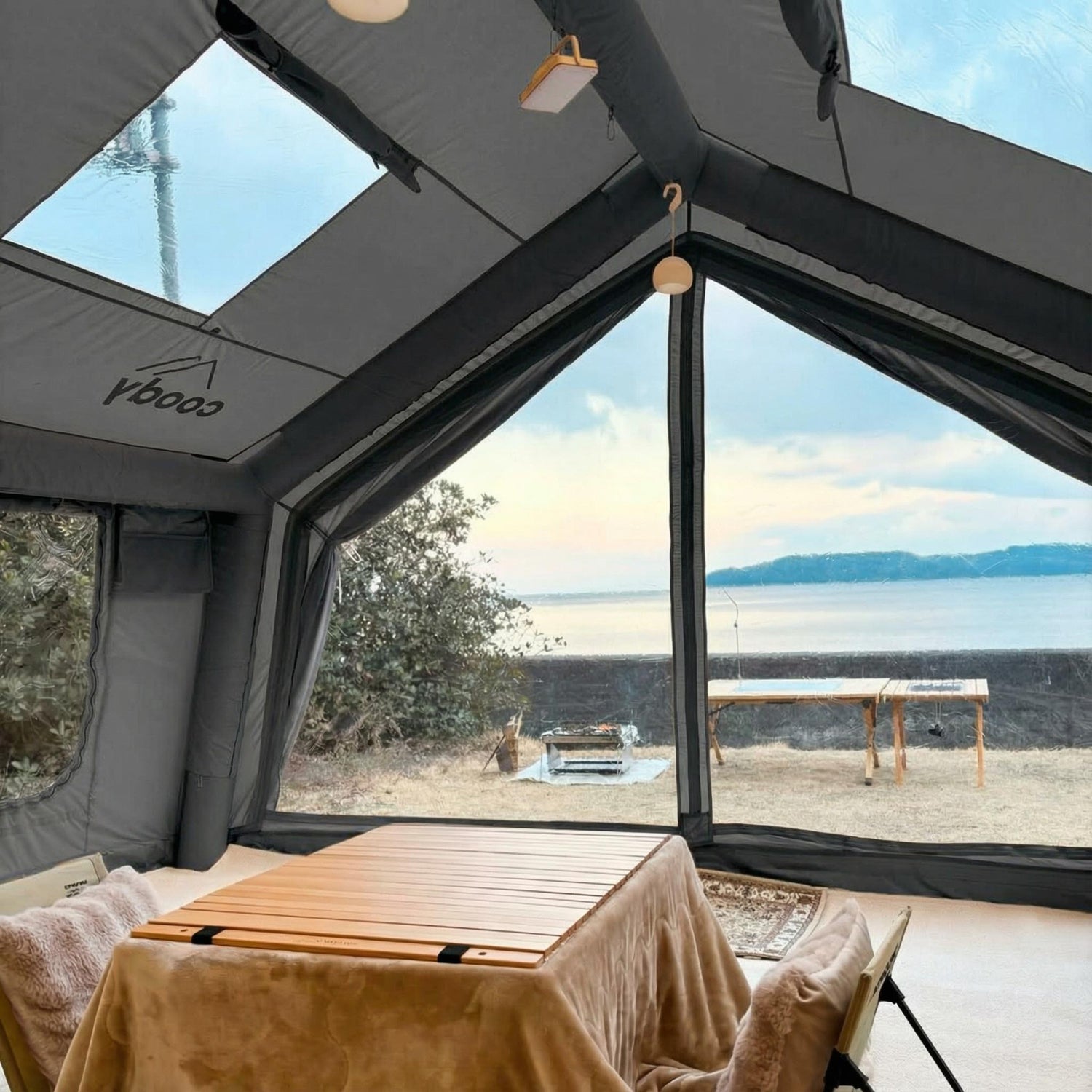
Breakfast with a view. A quiet corner to sleep. Space to settle in when the weather changes. Make your camp feel like your own place.
Close off the bedroom, screen just one side, or roll the divider away for a shared cabin. There is no raised threshold between the two rooms.

Manufacturer photographs show optional furniture and carpets.
The current 13.6 has a fixed PVC floor across both rooms, with a raised 5.9 in (15 cm) edge.
Video could not load. Open the clip
Choose light, airflow or privacy with layered window and door panels. Six windows, including two roof windows, keep the cabin connected to the outdoors.
Video could not load. Open the clip
Video could not load. Open the clip
Video could not load. Open the clip
Short demonstrations may show a different 13.6 color. Maintain ventilation with clear panels fitted; open or shade the tent in warm sunshine.

A canvas cabin you can settle into. The substantial 210 gsm TC fabric blends 65% polyester with 35% cotton for a breathable, textured interior that feels inviting on longer stays.
Research by Hes and Loghin identifies water-vapor and air transfer as important contributors to textile comfort, including in cotton/polyester woven fabrics. The study also shows that moisture affects these properties — so use your tent’s ventilation openings for fresh air and dry the canvas before storing it.
Hes & Loghin, 2009 — textile research. General fabric research, not a performance test of this tent.
Video could not load. Open the clip
Inflate the structure instead of assembling a conventional pole frame. The close-up shows the scale of the air beam beside a hand.

THE DETAILS BEHIND THE BUILD
Double-bonded air-beam seams reinforce the joins that hold air in the frame. Coody puts this construction detail at the center of its durability story — and here you can see the seam itself.
Coody’s manufacturer comparison shows a thicker sample at the inflatable frame: 0.55 mm versus 0.35 mm.

The clear-panel sample measures 0.40 mm versus 0.20 mm — twice the thickness of the comparison sample.
Manufacturer sample measurements. These compare air-beam and clear-panel materials, not the canvas fabric or every competing tent.
See Coody’s fan-test demonstration. The manufacturer reports completing a 72 km/h wind test.
Video could not load. Open the clip
Video could not load. Open the clip
A manufacturer-reported test result, not a guaranteed safe wind limit in every campsite condition. The airflow animation illustrates the tent’s shape; it is not a measured test.

A compatible tent stove can bring warmth and a cozy focal point to camp. The tent body has a designated 3.9 in (10 cm) stove-jack opening for planning the chimney route.
Stove and chimney sold separately. The standard rainfly has no factory stove jack; ask about the appropriate retrofit before using it with a stove. Follow stove clearances and ventilation requirements.

Dedicated cable and air-hose openings let you route compatible heating or cooling equipment and power into camp without running them through the main doorway.
Heater and ducts sold separately. Keep a diesel heater and its exhaust outside; bring only warm air into the tent.
Connect your Familia 13.6 to a compatible Coody tent or Hub with the optional Coody Tent Connector 3.6 + 3.6 — Gray ↗. Add a shared gathering space or a separate sleeping tent as your plans grow.


Video could not load. Open the clip
See the connector up close, step through the shared interior, and view the full campsite from above.
Video could not load. Open the clip
See how the rainfly can be arranged to extend the covered space beside the tent — a place for camp chairs, gear and unhurried mornings.
Choose level, well-drained ground. Clear sharp objects and fully unfold the tent before inflation.
Use the included hand pump and gauge. Close the valves and check pressure as temperatures change.
Secure all pegs and guy lines, fit the panels and tension the rainfly. Allow time for a complete pitch, beyond inflation alone.
Short, silent demonstrations. Colors and optional equipment may differ from the product selected.
Video could not load. Open the clip
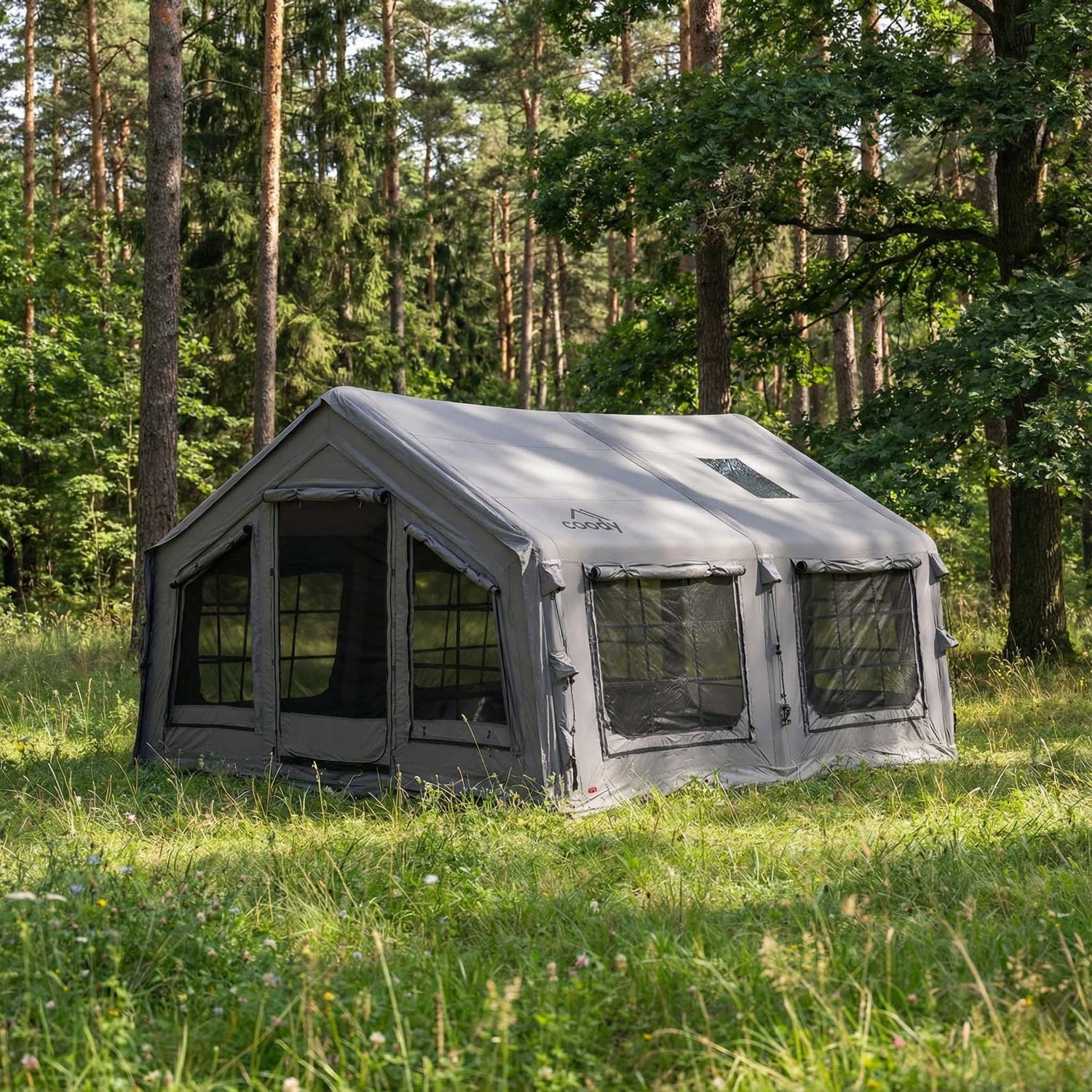
See the roof, windows and overall shape of the Forest Green 13.6.
Video could not load. Open the clip
Look through the cabin from one end to the other. See the side windows and curtain-style divider that lets you change the space.

Tap the diagram to view it larger.
Choose structured Coreo mattresses or Coody Air Mattresses with a built-in pump. Compare their exact footprints against the tent’s 137.8 in (350 cm) interior width. Both lines are 13.8 in (35 cm) high.
| Single ↗ | 41.3 × 78.7 in (105 × 200 cm) |
|---|---|
| Queen ↗ | 59.1 × 78.7 in (150 × 200 cm) |
| King ↗ | 70.9 × 78.7 in (180 × 200 cm) |
| Twin XL | 35.8 × 77.6 in (91 × 197 cm) | Beige ↗ Green ↗ |
|---|---|---|
| Queen | 59.1 × 77.6 in (150 × 197 cm) | Beige ↗ Green ↗ |
| King | 72.4 × 77.6 in (184 × 197 cm) | Beige ↗ Green ↗ |
Open-plan concepts with the divider open. Remaining width is arithmetic, not a measured walkway or verified bedroom fit; check room depth, air beams and door access. Mattresses are sold separately; Coreo pumps are sold separately. Product links open in a new tab.

No. The current 13.6 uses a continuous fixed PVC floor in both rooms, with a 5.9 in (15 cm) raised edge. It stays attached when you pack the tent.
The 2–8 person rating includes up to eight people in sleeping bags. A furnished camp with beds, chairs and a table needs more room per person. Plan your sleeping arrangement and keep both exits clear.
The standard tent includes the hand pump, rainfly, window and front-wall panels, pegs, preinstalled guy lines and two bags. Furniture, stove, external groundsheet, carpet, electric pump and connecting accessories are separate unless your chosen bundle explicitly includes them.
The tent body has a designated stove jack. The standard 13.6 rainfly does not have a factory stove jack. Ask us about the appropriate retrofit and chimney routing before combining a stove with the rainfly. Follow the stove instructions, maintain ventilation and clearances, and use working smoke and carbon monoxide alarms.
Beige, Forest Green, Black and Gray share the same 13.6 layout and listed equipment. The tent and floor colors change. Lighting can affect the appearance of fabric in photos; color is not a promise of a particular insulation or cooling performance.
Inflate to 6–8 psi using a pressure gauge. The frame includes a pressure-relief valve. Temperature changes affect pressure, so check it during your stay and never exceed the recommended range.
The approved operating range is 14–104°F (-10–40°C). That is an equipment operating range, not a sleeping-comfort rating. Use appropriately rated sleeping bags and insulated mats, maintain ventilation, use the rainfly as instructed, clear snow promptly, and dry the tent in a warm indoor space after freezing conditions.
TC canvas is breathable, but any tent can develop condensation when humid interior air meets a cold surface. Ventilate steadily, reduce indoor moisture and dry all parts thoroughly before storage.
Yes. Use the optional 3.6 + 3.6 connector to join the 13.6 to a standard Coody 10.0, 13.6, 17.2 or Hub. The 13.6 has one connection side. Pro-series connectors are different.
The packing demonstration at the beginning shows the tent being folded, rolled, placed in its bag and closed. Release the air fully, fold to the bag width and compress gradually. Do not force the zipper; dry the tent fully before storage.
Clear TPU panels preserve daylight and the view while covering the opening against direct wind. They are not cooling panels: sunlight can warm the interior. Use mesh, shade and ventilation to suit conditions.
No. Coody reports a 44.7 mph (72 km/h) fan test. Real gusts, ground, anchoring and setup differ, so this is a manufacturer test result rather than a guaranteed safe operating limit.
No. The complete kit weighs about 132.3 lb (60 kg) and is intended for vehicle-supported camping. Check the two packed box dimensions when planning transport and storage.


