
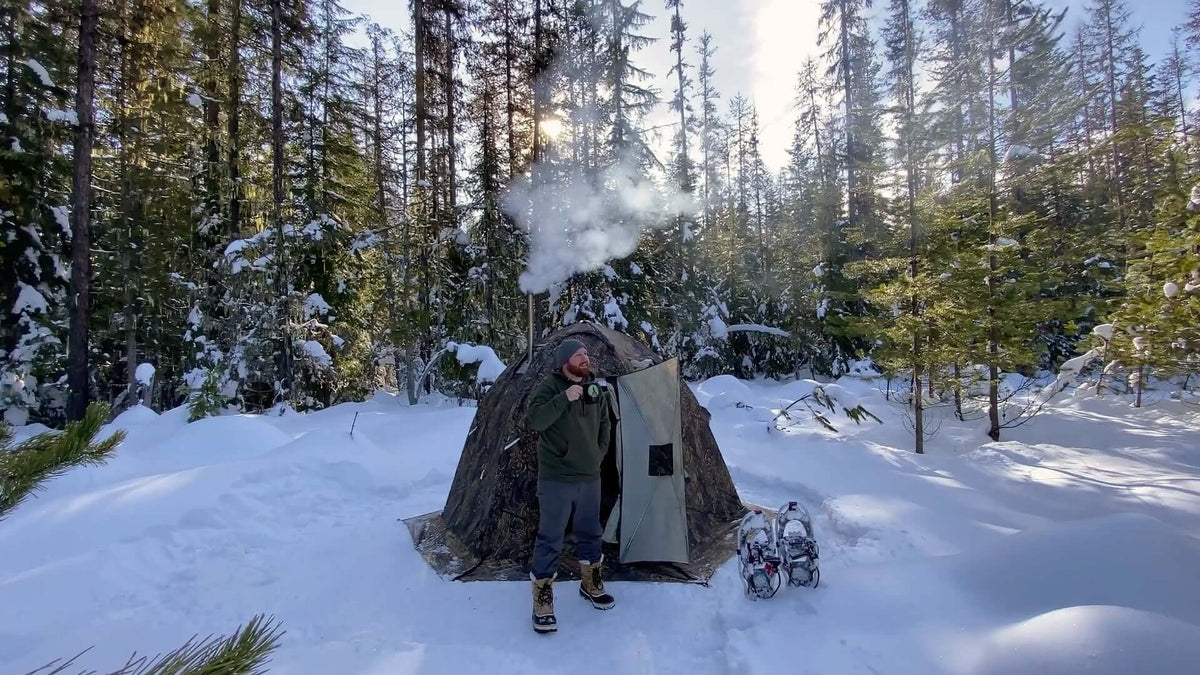
Une tente avec poêle associe une tente conçue pour l’utilisation d’un poêle à un poêle à bois compatible, une cheminée, un passe-tuyau résistant à la chaleur et une ventilation continue. L’objectif n’est pas simplement de produire davantage de chaleur. Une installation sûre doit diriger les gaz de combustion vers l’extérieur, protéger le tissu de la tente contre les surfaces chaudes du poêle et de la cheminée, maintenir une circulation d’air frais et préserver une sortie dégagée.
Ce guide porte sur les poêles à bois ventilés utilisés dans les tentes gonflables Coody et les tentes avec poêle RBM compatibles. Les instructions des tentes RBM interdisent les équipements au gaz et les appareils à combustible liquide à l’intérieur de la tente. Ne présumez jamais qu’un chauffage au propane portable est approuvé simplement parce qu’il est décrit comme adapté à une utilisation intérieure ; les instructions du chauffage et de la tente doivent expressément autoriser l’installation prévue.
Pourquoi un poêle à bois ventilé est différent
Un poêle à bois correctement installé évacue la fumée et les gaz de combustion vers l’extérieur par un conduit de cheminée étanche. Cela diffère d’un appareil de chauffage non ventilé à combustible, qui rejette directement les produits de combustion dans l’espace occupé. Une cheminée n’élimine pas tous les risques : un conduit obstrué, un tirage insuffisant, un raccord desserré, un poêle endommagé ou une alimentation en air inadéquate peuvent tout de même entraîner une accumulation de monoxyde de carbone.
Un poêle à bois peut réchauffer l’intérieur et favoriser l’évaporation de l’humidité présente sur les surfaces, mais il ne rend pas une tente résistante à la condensation. Les personnes, les vêtements mouillés, la cuisson et les écarts de température continuent d’ajouter de l’humidité. La ventilation doit rester ouverte pendant le fonctionnement du poêle.
Choisissez une tente conçue pour l’utilisation d’un poêle
Utilisez un poêle uniquement dans une tente équipée d’un passe-tuyau pour poêle résistant à la chaleur ou d’un passage de cheminée vérifié. Le diamètre de la cheminée, la conception du passe-tuyau, la paroi de protection, la protection du sol et les dégagements requis doivent être compatibles. La surface au sol seule ne suffit pas à déterminer la compatibilité.
Les tentes à armature double paroi RBM, telles que UP-2, UP-5, Cuboid 4.40 et Hexagon, utilisent une armature de type parapluie et une ouverture de cheminée intégrée. Leur plage de fonctionnement approuvée va de -50 °C à +45 °C (-58 °F à 113 °F). Les tentes avec poêle gonflables Coody utilisent des tubes d’air en PVC à une pression recommandée de 6-8 psi. Leur plage de fonctionnement approuvée va de -10 °C à +40 °C (14 °F à 104 °F). Après toute utilisation à une température inférieure à 0 °C, une tente gonflable Coody doit être entièrement séchée dans un espace intérieur chaud et sec avant d’être rangée.
Comparaison des performances et des caractéristiques
|
Article |
Capacité / utilisation |
Matériau / caractéristique |
Poids net |
Poids brut |
|
Tente d’hiver RBM UP-5 |
Jusqu’à 6 ; jusqu’à 5 avec un poêle |
Oxford 300D double paroi avec revêtement PU4000 |
29.5 kg (65.03 lb) |
37.5 kg (82.67 lb) |
|
2-8 personnes |
Tissu TC de 210 g/m² |
60 kg (132.28 lb) |
65 kg (143.30 lb) |
|
|
2-10 personnes |
Tissu TC de 210 g/m² |
66 kg (145.51 lb) |
72.5 kg (159.84 lb) |
|
|
Poêle à bois de taille moyenne pour tente |
Acier inoxydable AISI 430 et verre céramique |
16.5 kg (36.37 lb) |
29.74 kg (65.56 lb) |
Les chiffres de capacité indiquent le nombre de personnes dans la tente et ne garantissent pas une disposition particulière du mobilier. Un poêle, un tapis thermique, les dégagements requis, les lits de camp, les tables et l’équipement réduisent l’espace habitable et de couchage disponible.
Caractéristiques du poêle à bois Caminus M
Caminus M est un poêle à bois de taille moyenne pour tente, conçu pour chauffer les tentes chauffantes et cuisiner. Il est fabriqué en acier inoxydable AISI 430 et utilise des panneaux latéraux en verre céramique ignifuge de 4 mm (0.16"), conçus pour résister jusqu’à 750 °C (1382 °F). Le verre permet de surveiller le feu sans ouvrir la porte du foyer.
- Dimensions assemblé - 330 x 690 x 600 mm (12.99 x 27.16 x 23.62")
- Dimensions du foyer - 250 x 500 x 250 mm (9.84 x 19.68 x 9.84")
- Diamètre de la cheminée - 80 mm (3.15")
- Cheminée - 5 segments de 485 mm (19.09") de longueur chacun
- Hauteur totale avec cheminée - 2800 mm (110.23")
- Poids net - 16.5 kg (36.37 lb)
- Poids brut - 29.74 kg (65.56 lb)
Produits associés : Poêles de tente Caminus RBM Outdoors
Exemple sur le terrain : chauffer une tente Coody 17.2
Lors d’une démonstration vidéo en conditions réelles, un poêle Caminus M a fait passer la température intérieure signalée d’une tente Coody 17.2 de -5 °C (23 °F) à +22 °C (72 °F) en environ 15 minutes. Il s’agit d’une observation effectuée sur un seul site de camping, et non d’un test contrôlé en laboratoire ni d’une vitesse de chauffage garantie. Les résultats varient selon la température extérieure, le vent, la ventilation, la configuration de la tente, le combustible, l’état du poêle et l’emplacement de la mesure.
Liste de contrôle de sécurité pour un poêle de tente chauffante
- Effectuez le premier allumage à l’extérieur pendant au moins 1 heure afin d’éliminer la graisse technique et les émissions initiales du produit d’étanchéité.
- Placez le poêle sur une surface plane et stable, avec le tapis ignifuge fourni placé dessous.
- Maintenez un dégagement d’au moins 50 cm (19.6") entre le poêle et les objets environnants.
- Ne placez pas le poêle dans une entrée, un passage ou à tout autre endroit qui bloque la sortie.
- Raccordez fermement chaque section de cheminée et vérifiez que le tirage de la cheminée n’est pas obstrué avant d’utiliser le poêle.
- Maintenez la sortie de cheminée à au moins 50 cm (19.6") au-dessus du faîte de la tente et utilisez le pare-étincelles et le déflecteur requis.
- Maintenez une ventilation continue et veillez à ce que l’arrivée d’air du poêle ne soit pas obstruée.
- Utilisez des détecteurs de fumée et de monoxyde de carbone en état de marche chaque fois que le poêle fonctionne.
- Ne remplissez pas le foyer au-delà des deux tiers de son volume afin que l’air puisse circuler.
- Gardez la porte du foyer fermée, sauf lors du chargement du combustible.
- Ne laissez jamais un poêle en fonctionnement sans surveillance et n’utilisez jamais d’appareil de chauffage portable à combustion pendant votre sommeil dans une tente.
- Ne chauffez pas le poêle en continu pendant plus de 7 heures.
- Nettoyez la cheminée après chaque tranche de 10 heures d’utilisation du poêle.
- Laissez le poêle refroidir complètement avant de le déplacer, de le démonter ou de le ranger.
Monoxyde de carbone et ventilation
Le monoxyde de carbone est incolore et inodore. Les premiers symptômes peuvent inclure des maux de tête, des étourdissements, une faiblesse, des nausées, des vomissements, de la somnolence et de la confusion. Si une alarme retentit ou si quelqu’un présente des symptômes, éteignez la source de chaleur si vous pouvez le faire en toute sécurité, quittez immédiatement la tente, allez à l’air frais et demandez une aide d’urgence.
Un détecteur de monoxyde de carbone offre une protection supplémentaire, mais ne remplace pas une installation correcte, l’entretien de la cheminée, une ventilation continue ni une surveillance. Ne bouchez pas toutes les portes et ouvertures d’aération pour tenter de conserver davantage de chaleur.
Référence de sécurité : Recommandations de la Commission américaine de sécurité des produits de consommation concernant les appareils de chauffage portables et l’équipement de camping
Restez au chaud et en sécurité : Ne laissez pas les températures glaciales écourter votre aventure. Équipez votre camp de nos tentes chauffées 4 saisons premium et de nos poêles à bois fiables, conçus pour offrir une sécurité et un confort optimaux par mauvais temps.
Tentes chauffées 4 saisons
Voir la collectionPoêle à bois Caminus M
Voir le produitUtilisation et rangement par temps froid
Respectez la plage de température publiée pour la tente concernée. Pour les tentes gonflables Coody, surveillez la pression d’air, car elle peut changer lorsque la température varie. Ne forcez pas le PVC rigide et froid dans des plis serrés. Après une utilisation à une température inférieure à 0 °C (32 °F), placez la tente dans un espace intérieur chaud et sec, puis séchez complètement chaque partie du tissu, du sol et des boudins d’air avant de la ranger.
Pour les tentes à armature RBM, fixez la tente avec toutes les haubans et tous les piquets requis. Le manuel de la tente RBM indique que la tente ne doit pas être utilisée par des vents supérieurs à 61 km/h (38 mph). La neige ne doit pas s’accumuler sur le toit ; retirez-la rapidement et réévaluez le site de camping lorsque les conditions se détériorent.
Foire aux questions
Peut-on utiliser un appareil de chauffage au propane à l’intérieur d’une tente avec poêle RBM ?
Non. Les instructions des tentes RBM interdisent les appareils au gaz et les appareils à combustible liquide à l’intérieur de la tente. Ce guide porte sur un poêle à bois ventilé compatible, installé à travers le passe-tuyau prévu à cet effet. Ne remplacez pas cet appareil par un autre système de chauffage, sauf si les instructions à jour de la tente et de l’appareil de chauffage autorisent explicitement cette utilisation.
Puis-je dormir pendant qu’un poêle de tente ou un appareil de chauffage fonctionne ?
Non. Le poêle ne doit pas être laissé sans surveillance, et la U.S. Consumer Product Safety Commission déconseille d’utiliser des appareils de chauffage portables à combustible pendant le sommeil dans un espace clos comme une tente.
Un poêle élimine-t-il la condensation ?
Non. Le chauffage peut aider l’humidité de surface à s’évaporer, mais les occupants, la cuisine et l’équipement mouillé continuent d’ajouter de l’humidité. Assurez la ventilation et séchez complètement la tente après utilisation.
Comment savoir si un poêle convient à ma tente ?
Vérifiez le diamètre de la cheminée du poêle, la conception du passe-tuyau de la tente, les protections requises et résistantes à la chaleur pour le mur et le sol, ainsi que les instructions de compatibilité du fabricant. Ne choisissez pas un poêle uniquement en fonction de la capacité de la tente ou de la superficie du sol.
Peut-on utiliser des bougies pour chauffer une tente ?
Non. Les bougies fournissent très peu de chaleur utile et introduisent une flamme nue, un risque d’incendie, de la suie et des gaz de combustion. Utilisez des matelas de sol isolants, des sacs de couchage adaptés, des vêtements superposés et uniquement un système de chauffage approuvé.
Conclusion
Le chauffage sûr d’une tente avec poêle commence par la compatibilité de l’équipement et une utilisation rigoureuse. Utilisez une tente conçue pour un poêle à bois, installez la cheminée et les protections thermiques exactement comme indiqué, assurez une ventilation continue, utilisez des détecteurs de fumée et de monoxyde de carbone, et ne laissez jamais le poêle sans surveillance. Les plages de température vérifiées aident à choisir le bon abri, mais elles ne remplacent pas l’évaluation des conditions météorologiques, un ancrage solide, un équipement de couchage approprié, ni le séchage et l’entretien complets après le séjour.
0 commentaire