
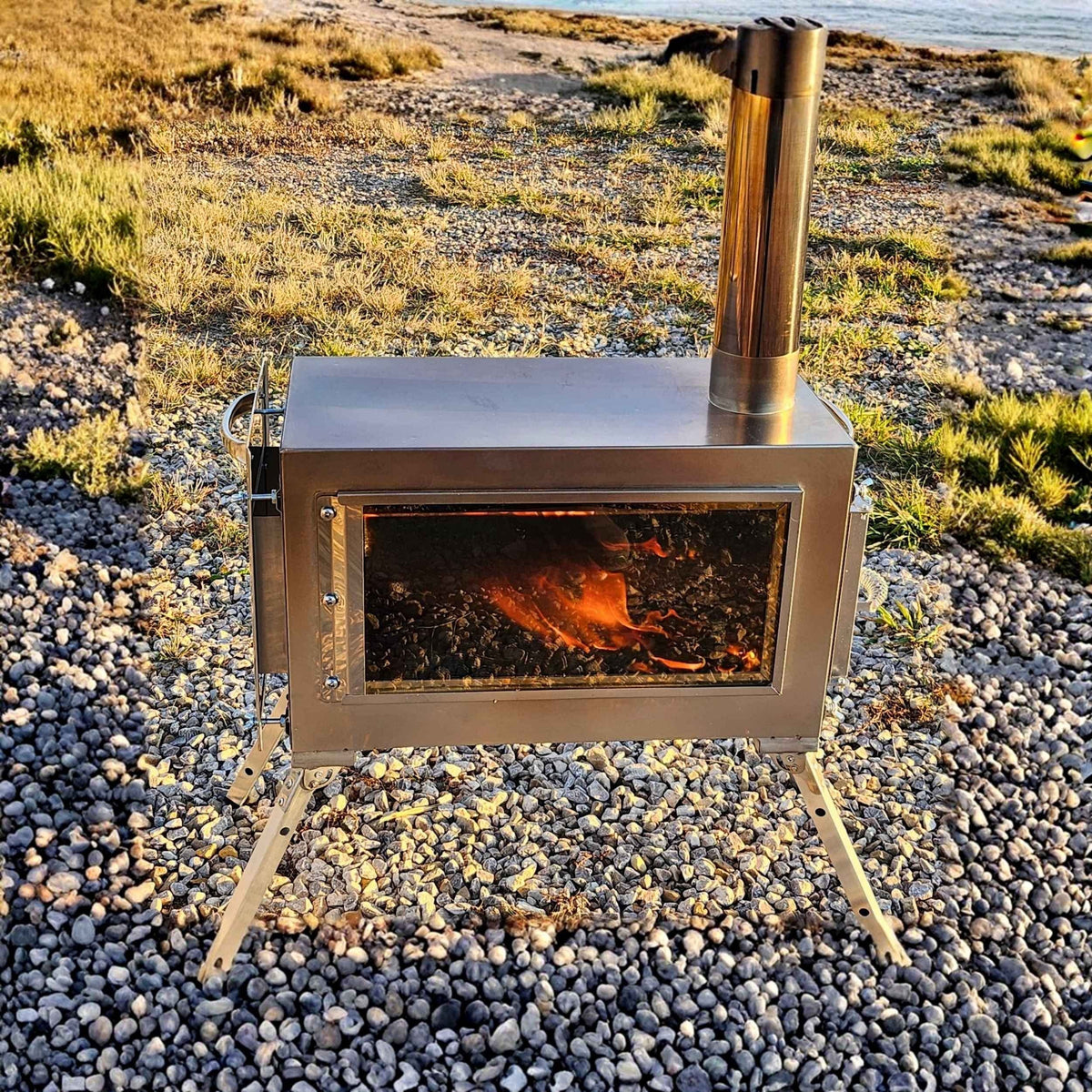
A tent wood stove must be treated as a complete system: compatible tent, heat-resistant stove jack, stable stove, fire-resistant floor mat, tightly connected chimney, spark arrestor, ventilation, and working smoke and carbon monoxide alarms. Improvised openings, unsupported chimney routes, and unattended operation create serious fire and carbon monoxide hazards.
1. Confirm tent and stove compatibility
Use a stove only in a tent designed for that purpose. Confirm the chimney diameter, stove-jack construction, heat-resistant wall, floor protection, and clearance requirements. A tent's capacity or floor area alone does not establish stove compatibility. RBM instructions prohibit gas equipment and liquid-fuel devices inside the tent.
2. Complete the first firing outdoors
The Caminus manual requires the first firing to be completed outdoors for at least 1 hour. This burns off technical grease and allows initial sealant emissions to dissipate. Do not perform the burn-off inside the tent.
3. Prepare a level stove location
- Choose a level, stable surface inside the designated stove zone.
- Place the supplied fire-resistant stove mat directly beneath the stove.
- Keep at least 50 cm (19.6") between the stove and surrounding objects.
- Keep the stove, fuel, and accessories out of entrances and passageways.
- Do not dry clothing, footwear, fuel, or other materials on the stove or chimney.

4. Assemble the chimney
Connect each chimney segment tightly and route the pipe through the designated stove jack. The chimney outlet must extend at least 50 cm (19.6") above the tent ridge. Install the spark arrestor and required deflector, and secure the system so wind or accidental contact cannot shift it.
Caminus S uses a 65 mm (2.56") chimney with seven 300 mm (11.81") segments. Caminus M uses an 80 mm (3.15") chimney with five 485 mm (19.09") segments. Confirm the complete approved configuration rather than matching components by diameter alone.
5. Establish draft and ventilation
Before building a larger fire, confirm that the chimney has draft and that smoke moves into the stove and up the flue. Keep the stove's air supply unobstructed and maintain continuous tent ventilation. Never seal all vents and doors in an attempt to retain more heat.
6. Operate within the stove limits
- Load fuel to no more than two-thirds of the firebox volume.
- Keep the firebox door closed except while loading fuel.
- Use the included gloves when handling hot stove components.
- Never leave an operating stove unattended and do not sleep while a portable fuel-burning heater is operating.
- Do not heat the stove continuously for more than 7 hours.
- Never pour water into the combustion chamber or move the stove before it is completely cool.
The current Caminus manual contains conflicting statements about coal. This guide therefore does not authorize coal or any other fuel type. Use only fuel permitted by the current instructions supplied with the specific stove.
Stay Warm & Safe: Equip your hot tent with our reliable, premium wood-burning stoves. Designed with heat-resistant ceramic glass and high-quality stainless steel for a comfortable and secure winter camping experience.
Caminus S Wood Stove
View ProductCaminus M Wood Stove
View Product7. Monitor carbon monoxide
Use working smoke and carbon monoxide alarms whenever the stove operates. Carbon monoxide is colorless and odorless. Symptoms can include headache, dizziness, weakness, nausea, vomiting, sleepiness, and confusion. If an alarm sounds or symptoms appear, leave the tent immediately and seek emergency assistance.
8. Clean and cool the system
The Caminus manual requires chimney cleaning after every 10 hours of use. Allow the stove and all pipe sections to cool completely before disassembly. Inspect the glass, chimney joints, spark arrestor, heat shields, mat, and stove jack before the next use.
Frequently Asked Questions
Can the chimney run horizontally through a tent wall?
Do not improvise a horizontal route. Install the chimney through the tent's designated stove jack and follow the current tent and stove diagrams.
Can I close the damper completely for a longer burn?
Do not use an improvised overnight setting. Maintain sufficient draft, follow the supplied stove instructions, and never leave the stove operating unattended.
Does an insulated floor replace the stove mat?
No. A three-layer floor provides ground insulation; it is not a substitute for the fire-resistant stove mat required beneath the stove.
Safety reference: CPSC guidance for portable heaters and camping equipment
0 comments