
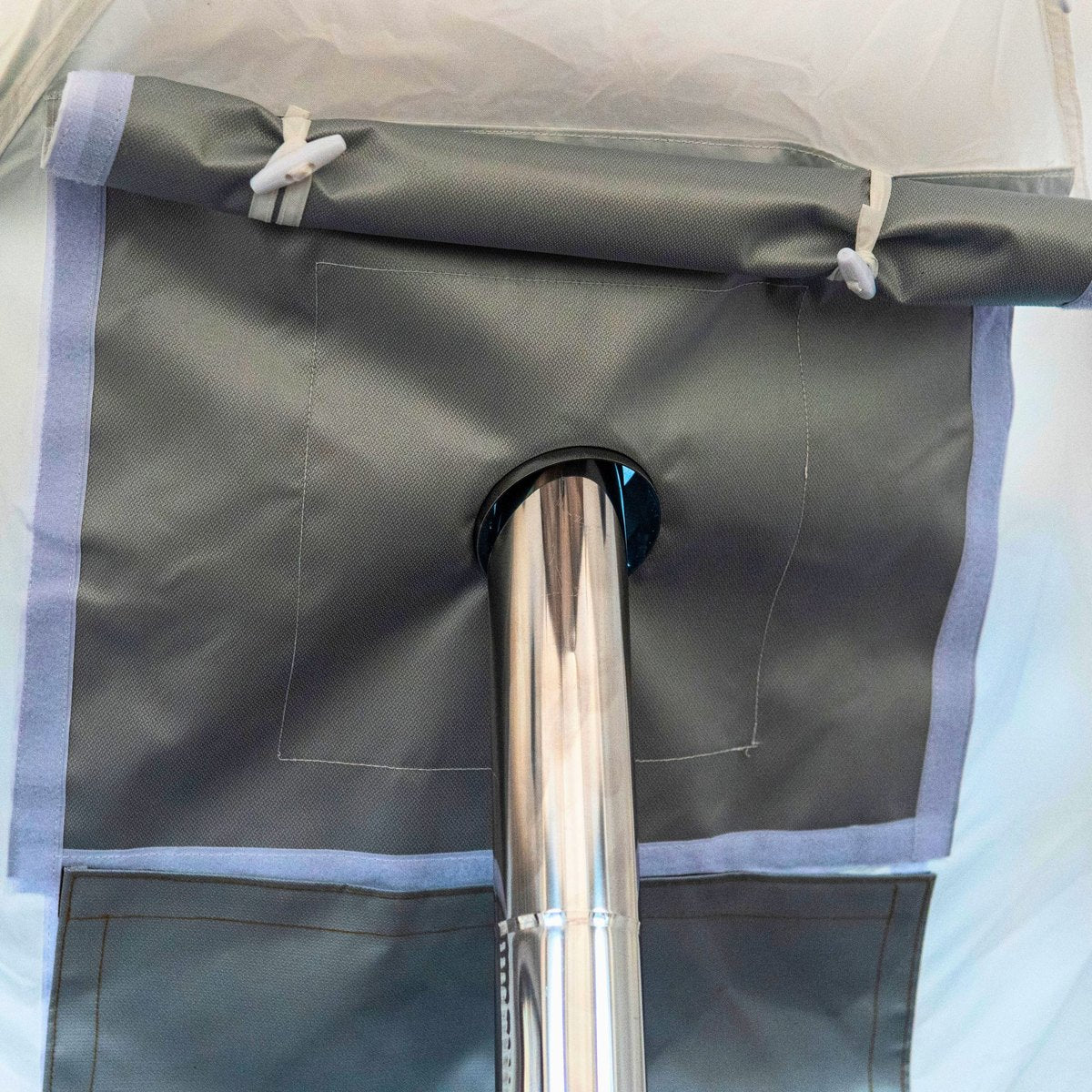
A stove jack is a heat-resistant pass-through that allows a wood-stove chimney to exit a tent. Some rainflies also have a dedicated chimney opening. The jack protects the designated fabric crossing; the stove, chimney, clearances, floor protection, and ventilation must still work together. RBM frame tents include a built-in jack.

Why a stove jack matters for winter and hot tenting
Product descriptions may call it a tent stove pipe hole or a wood-stove chimney jack. Look for the heat-resistant pass-through, not an ordinary fabric opening.
Picture a rainy evening at camp: the beds are set up, wet clothing needs a place to dry, and you want warmth without leaving an entrance partly open for the pipe. A hot tent with a stove jack provides a designated chimney route. You can plan the stove position and living space around it before the trip.
The jack is not an exhaust fan, and it does not make the entire fabric fireproof. Chimney draft carries combustion gases outside; dedicated ventilation supplies fresh air and helps manage moisture. Keep those functions separate when you inspect the setup. Closing every vent to hold warmth defeats the airflow your occupied camp needs.
If you are still choosing the shelter, our winter camping tent selection guide covers people, stove space, and transport. Here, the focus is the pipe crossing and what changes when a rainfly is fitted.
Stove jack on the tent vs on the rain fly
The tent's stove jack provides a designated chimney exit. On models with a factory stove jack in the rainfly too, the pipe passes through both layers, so the rainfly stays in place and continues to protect the tent from precipitation. Align the dedicated openings as instructed. There is no need to fold back the rainfly or cut ordinary fabric.
| Tent type | Primary weather protection | What to check for stove use |
|---|---|---|
| RBM UP models and Hexagon | Oxford 300D outer shell, PU 4000 mm; no separate rainfly needed. | Use the tent's built-in jack and the recommended chimney arrangement. |
| RBM Cuboid 4.40 | Outer shell plus an included additional rainfly recommended for heavy rain. | Confirm the supplied cover's intended chimney route before using the stove with it fitted. |
| RBM Panda and Coody Pro tents | RBM Panda Medium and Large, Coody Familia 17.2 Pro, Coody 10.0 Pro, and Coody Hub Pro have a stove jack in the included rainfly as well as in the tent. | Align the rainfly opening with the tent's stove jack and fit the chimney through both as instructed. |
| Standard Coody models | Coody 8.0, 10.0, Familia 13.6, Familia 17.2, and Hub rainflies do not have a factory-sewn stove jack. | A stove jack can be sewn into the rainfly using a separately purchased installation kit. Complete the installation before routing a hot chimney through the rainfly. |
Standard Coody 8.0, 10.0, Familia 13.6, Familia 17.2, and Hub rainflies have no factory-sewn stove jack. A separately purchased complete installation kit allows one to be sewn in; follow its instructions before use. Confirm the kit for your exact rainfly with support before ordering. Coody Pro rainflies already have the jack sewn in. Never route a hot pipe through a plain cutout.

Pipe size and stove match
A 3.54 in (90 mm) stove jack does not mean you should buy a 3.54 in pipe. The jack opening and the chimney diameter are different measurements. RBM's five current frame models have that opening; the recommended Caminus S pipe is 2.56 in (65 mm), while Caminus M uses 3.15 in (80 mm). Model compatibility and installation instructions, not equal diameters, determine the pairing.
Caminus S and M combine a built-in spark arrestor with heat-resistant ceramic-glass side panels. The arrestor helps limit sparks leaving the stove system; the glass lets you watch combustion and see when the fire needs attention without opening the loading door.
| Stove / source | Chimney diameter | Firebox | RBM frame-tent pairing |
|---|---|---|---|
| Caminus S | 2.56 in (65 mm) | 9.05 × 12.59 × 7.87 in (230 × 320 × 200 mm) | UP-2 Mini; also recommended for UP-2. |
| Caminus M | 3.15 in (80 mm) | 9.84 × 19.68 × 9.84 in (250 × 500 × 250 mm) | UP-2, UP-5, Hexagon, and Cuboid 4.40. |
M gives you a larger firebox; S is the compact option. Neither choice removes the need to check chimney height and the complete installation. Do not estimate suitability by subtracting the tent's peak height from an assembled stove measurement. Use the current Caminus instruction manual and the selected tent's instructions.
Stove dimensions checked November 3, 2026 against the Caminus manual.

Browse the Caminus stove collection for the recommended model. A stove jack is one part of the setup, not permission to fit an arbitrary pipe or unapproved adapter.
Safe stove setup when it is raining
Rain protection should stay intact when the stove is in use. Do not fold back a corner of the rainfly to make room for the chimney: that can expose the interior to rain and bring loose fabric toward hot components. Plan the intended chimney route before lighting the fire, while every component is cool.
- Pitch and anchor the tent completely. Choose a level site where water will not collect. Set the stove location with the exits and normal walking routes clear.
- Inspect the jack and chimney. Check the heat-resistant opening, surrounding stitching, pipe sections, and connections. Do not operate with a damaged jack or faulty chimney.
- Fit the rainfly correctly, if used. Use only the cover's designed chimney route. If it has a dedicated opening, align it with the tent opening without pulling ordinary fabric against the pipe. Stop if the arrangement cannot be fitted as intended.
- Complete the chimney assembly. Follow the Caminus manual’s requirements for outlet height, secure section connections, and use in rain or wind. Confirm that the assembled chimney has draft before lighting.
- Check the built-in spark arrestor. Keep it clean and unobstructed as directed. A rain cover is not a substitute for spark control.
- Protect the floor and preserve airflow. Use the heat-resistant mat and specified clearances. Keep ventilation and the stove's air supply unobstructed, with working smoke and carbon monoxide alarms.
- Tend the fire and monitor the setup. Keep fuel and wet gear outside the required clearances. Never leave the burning stove unattended or operating while everyone sleeps. Let it cool fully before changing the installation.
UP models include a heat-resistant wall. Hexagon and Cuboid are designed to place the stove farther from the tent wall, so a separate heat-resistant panel is not included. In either layout, keep the clearances in the stove instructions; a protective panel does not create extra space for furniture or firewood.
Our wood-stove safety guide covers operation in more detail. The hot-tent heating guide and stove and chimney installation guide cover preparation. For chimney care, use the maintenance guide together with the current stove manual.
Which RBM tents include a stove jack
If you search for a four-season tent with a stove jack, compare each model’s published operating range and stove arrangement. UP-2 Mini, UP-2, UP-5, Hexagon, and Cuboid 4.40 all include a built-in 3.54 in (90 mm) opening. Choose among these RBM frame tents by capacity with the stove, entrance design, and transport requirements. The built-in jack is standard, not an optional accessory.
If you want an ice fishing tent with a stove jack, also check floor access. RBM frame tents have removable standard floors and include ice screws; optional three-layer UP floors provide dedicated fishing openings.
Inflatable examples include RBM Panda Large and Coody Familia 17.2. Their model-specific stove and rainfly arrangements need their own check. Our inflatable tent with stove jack guide explains that selection route. If you are comparing heating methods before choosing equipment, see our tent-heating overview.
Stove jack checklist before you buy
Choose the tent, stove, and weather cover as a system. Before ordering, confirm these five points:
- The exact tent model has the factory stove jack you need.
- The opening size and recommended stove are confirmed for that model.
- You understand the chimney route with any rainfly fitted.
- Your layout leaves the required clearances and entrances free.
- The selected order includes the stove, chimney parts, and floor protection you expect, or you have added them separately.
Ready to choose the combination? Explore RBM tent-and-stove bundles, and check the contents of the selected set before ordering.
Frequently asked questions
What is a stove jack?
It is the heat-resistant pass-through for a wood-stove chimney. It provides the designated fabric crossing, while the full installation still needs the correct stove, chimney, clearances, floor protection, and ventilation.
Do all RBM tents have a stove jack?
The five current RBM frame models listed here do. For an inflatable or another shelter, check its exact product specification rather than assuming the whole catalog has the same arrangement.
What size pipe fits the jack?
Use the chimney supplied for your recommended stove and follow the installation instructions. Caminus S uses 2.56 in (65 mm); M uses 3.15 in (80 mm). Check the full tent-and-stove arrangement rather than selecting a pipe from the jack opening alone.
Does the rainfly need a stove jack too?
If a rainfly covers the chimney route, it needs a designed way for the pipe to pass through. Use the model's intended arrangement. UP models and Hexagon do not require a separate rainfly.
What if I want to run the stove in the rain?
Keep the weather cover correctly fitted, use the designated chimney route, and maintain ventilation. Follow the Caminus manual’s rain and wind requirements for the complete chimney assembly. Do not lift a corner or create an improvised pipe exit.
Is the tent fabric fireproof?
No. The heat-resistant stove jack does not make the surrounding tent fabric fireproof. Keep hot surfaces and sparks away from fabric and gear, and follow the Caminus requirements for clearances and ventilation.
Which Caminus stove should I choose?
RBM recommends S for UP-2 Mini, S or M for UP-2, and M for UP-5, Hexagon, and Cuboid 4.40. Check the complete installation as well as the model pairing.
Where can I check an inflatable tent's rainfly opening?
Check the rainfly details on the exact model’s product page and confirm any unclear opening with support. RBM Panda Medium and Large, Coody Familia 17.2 Pro, 10.0 Pro, and Hub Pro have factory-sewn rainfly stove jacks. Standard Coody 8.0, 10.0, Familia 13.6, Familia 17.2, and Hub do not. A separately purchased complete kit allows one to be sewn in; install it only as instructed.
This guide is for general reference. Follow the instructions supplied with your tent and stove. To confirm compatibility or installation details for your setup, email info@hot-tent.com with your tent and stove model names.
0 comments